

.svg)
.svg)

What we'd do if it were our money
The Free Marketing Tools a Small Business Can Actually Run On in 2026
Updated July 2026. All pricing and free tier limits verified against vendor pricing pages and independent trackers in July 2026.
Most "free tools" lists are affiliate link farms. They list forty products, half of which are free trials rather than free tiers, and none of which are tested against what a real small business needs to do in a week. Worse, most of them are years stale, which matters because free tiers have been shrinking steadily.
This is the shorter, more useful version: a complete marketing stack a small business can run on for close to $0 a month, category by category, with current free tier limits and the specific point where each tool stops being free. JG Collective runs most of this stack itself, and the honest verdicts below include the tools whose free tiers have been cut enough that they are no longer worth building a process around.
One definition first. Free tier means permanently free with limits. Free trial means it stops working in 14 days. This list is free tiers only, with the ceiling stated for each.
One warning. Free tiers contracted noticeably across 2025 and 2026. MailerLite cut its free plan twice in under a year. Hootsuite eliminated its free tier entirely. Build on free tiers knowing they are a feature, not a contract.
The complete stack, at a glance
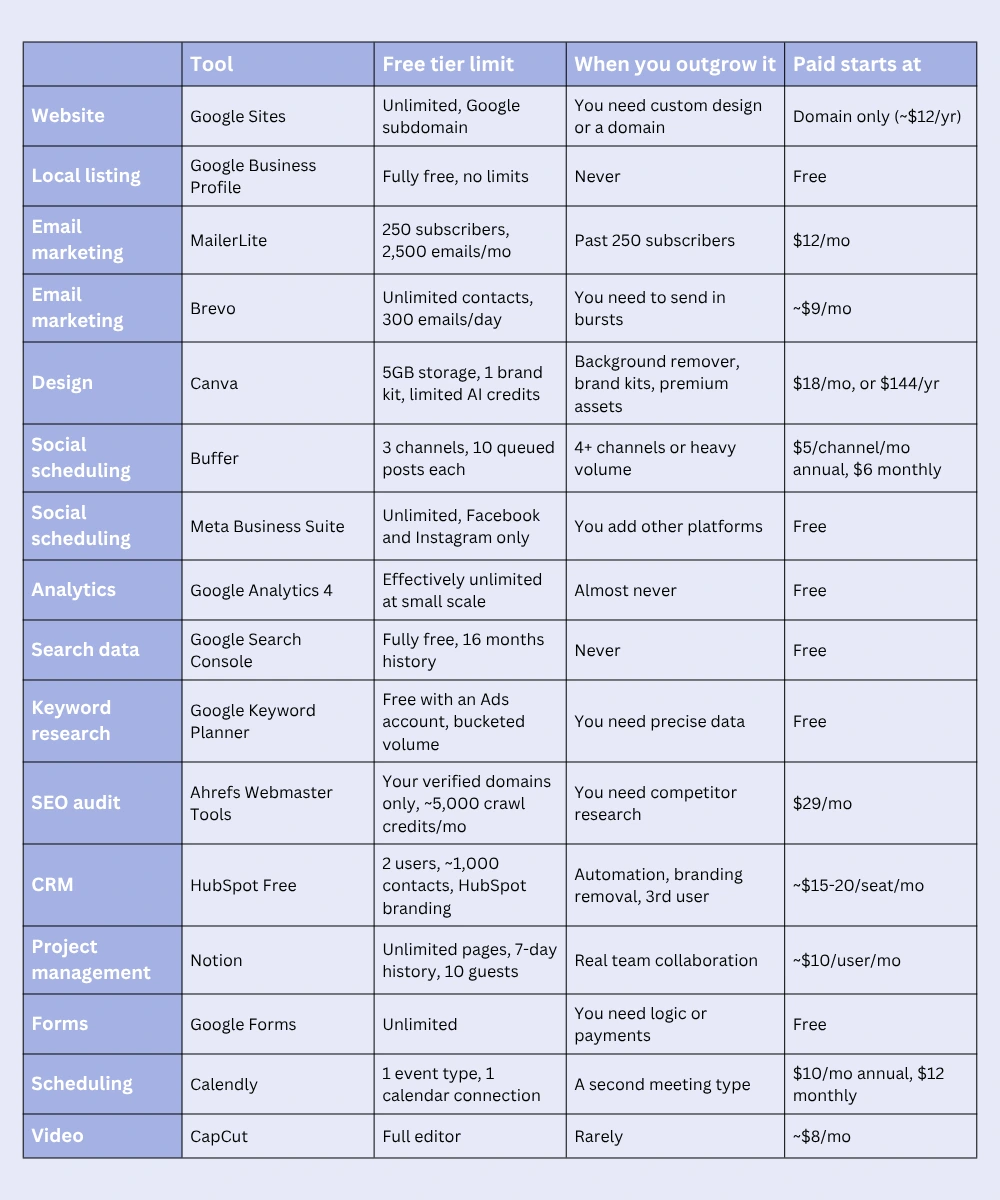
Category by category
Website
Google Sites is genuinely free forever and genuinely limited. No plugins, minimal design control, and it looks like what it is. For a service business that mainly needs a findable page with correct information and working contact details, that is often enough. Connect a custom domain and it stops looking like a hobby project.
Honest verdict: this is the category where free costs you the most. A website is the one asset AI engines and customers both read, and a $12 domain plus cheap hosting is the highest-return money a small business spends. Start free if you must, but plan to leave.
Local listings
Google Business Profile is free, unlimited, and the single highest-leverage free asset a local business owns. It feeds Google Maps, Google AI Overviews, and, indirectly, every other AI engine through the directories that mirror it.
Also free and also worth doing: Apple Business Connect, Bing Places, and Yelp's basic listing. Same information, formatted identically across all four. Inconsistency across listings is one of the most common reasons AI engines fail to recognize a business as a single entity.
Honest verdict: nothing else on this list returns as much for zero dollars. If you do one thing from this post, do this.
Email marketing
This category changed the most, and not in your favor.
MailerLite was the standard recommendation for years at 1,000 subscribers and 12,000 monthly emails. In September 2025 it halved the subscriber cap to 500. Effective July 1, 2026, the free plan dropped again to 250 subscribers and 2,500 emails per month, with caps of 3 automations, 3 forms, and 1 landing page. Enforcement of the feature limits begins August 13, 2026. Paid plans start at $12 per month.
Free MailerLite is now closer to a sandbox than an operating tier. If your list is above 250, you cannot send until you upgrade or trim.
Brevo stores unlimited contacts but caps sending at 300 emails per day, roughly 9,000 a month. Better if you have a large list you email rarely. Worse if you want to send one campaign to everyone on a Tuesday morning.
Honest verdict: Brevo is now the more generous free tier for most small businesses, which is a reversal from a year ago. MailerLite is still the better product, and you should expect to pay for it almost immediately.
Design
Canva free includes 5GB storage, over a million templates, real-time collaboration, and standard exports. What sits behind Pro: background remover, magic resize, brand kits beyond one basic kit, premium assets, and meaningfully higher AI limits.
Canva Pro is $18 per month billed monthly, or $144 per year, which works out to about $12 a month annually.
Honest verdict: free Canva is sufficient for a year or more of light use. When you do upgrade, it is one of the few subscriptions that clearly pays for itself in time saved.
Social scheduling
Buffer free gives 3 connected channels with 10 queued posts each, so 30 posts in the queue at once. The 10-post cap is a rolling queue, not a monthly limit: when a post publishes, the slot reopens. Paid is per channel, $5 per channel per month billed annually or $6 monthly.
Meta Business Suite schedules Facebook and Instagram with no limits at all, because Meta wants you posting. If those two are your whole social presence, this is free forever with no ceiling.
Worth noting for context: Hootsuite eliminated its free plan in 2023 and has not brought it back, so Buffer is close to the last real free option among the major schedulers.
Honest verdict: Meta Business Suite for Facebook and Instagram only. Buffer once you add a third platform. Do not pay for scheduling until the manual version genuinely costs you hours.
Analytics and search data
Google Analytics 4 is free and effectively unlimited at small business scale. The interface is worse than the old version and it is still the standard.
Google Search Console is free, permanently, with 16 months of query history, and it is the only place you see the actual searches bringing people to your site. Most small businesses never set it up, which is a significant unforced error.
Honest verdict: both, immediately, day one. There is no version of this where paying for analytics makes sense before you have exhausted these.
SEO and keyword research
Google Keyword Planner is free with an Ads account, and you do not have to run ads to use it. Volume data is bucketed rather than precise unless you are spending, but the directional data is real.
Ahrefs Webmaster Tools gives you a genuine site audit, backlink data, and an organic keywords report for domains you verify as your own, with roughly 5,000 crawl credits per project per month. You cannot research competitors, which is the actual product Ahrefs sells. Paid plans start at $29 per month.
Honest verdict: these two cover diagnosis of your own site. What free tools cannot give you is competitor research, and that is the gap that eventually justifies paying.
CRM
HubSpot Free is still generous, but tighter than its reputation suggests and tighter than most lists claim. Current free tier: 2 users, roughly 1,000 contacts for newer accounts, 1 deal pipeline, limited custom properties, and HubSpot branding on all assets. You get contact and deal records, email tracking, live chat, forms, and meeting scheduling.
Older accounts and some hub configurations show much higher contact allowances, and reporting on this varies by source. Verify your own account limits rather than trusting any published number, including this one.
Paid starts around $15 per seat per month billed annually, roughly $20 month-to-month, and the jump from Starter to Professional is severe: Marketing Hub Professional starts near $890 a month with a mandatory onboarding fee.
Honest verdict: use it, and go in knowing both the free ceiling and the size of the cliff above Starter. Free HubSpot is a very well-designed on-ramp, and the on-ramp is the product.
Project management
Trello free gives unlimited cards, unlimited Power-Ups, and up to 10 boards per workspace, 10 collaborators, 250 automation runs a month, and a 10MB per-file cap. The collaborator limit usually bites before the board limit does. Paid is $5 per user per month billed annually, $6 monthly.
Notion free is unlimited pages but keeps only 7 days of page history and caps external guests at 10. Paid is around $10 per user per month.
Honest verdict: Trello if you want it working in ten minutes. Notion if you enjoy building systems, and be honest with yourself about whether you do. Notion's failure mode is spending three weekends building a workspace instead of doing marketing.
Forms and scheduling
Google Forms is unlimited, free, and plain-looking. For a basic contact form, a survey, or a lead capture form, it does the job at zero cost with no ceiling.
Calendly free gives one event type and one calendar connection, with unlimited meetings on that one event type. The single calendar connection matters more than people expect: Calendly checks only that one calendar for conflicts, so if you keep work and personal calendars separate, free will double-book you. Paid is $10 per seat per month billed annually, $12 monthly.
Honest verdict: Google Forms for anything customer-facing on a budget. Calendly free only if you offer exactly one kind of meeting and keep one calendar.
Video
CapCut is a full mobile and desktop editor for free, and it is what most short-form video is actually made in. For a local business, real footage of your actual location, team, and work beats anything generic, both for customers and for how AI systems understand your business.
Honest verdict: use CapCut, and shoot your own footage rather than leaning on generic clips.
What to skip
Free tiers that cost more in setup time than they return:
Free website builders with heavy branding. If the free plan puts someone else's logo on your site, the credibility cost exceeds the savings.
Email free tiers under 500 contacts as a foundation to build on. You will hit the wall during your first real campaign and have to migrate mid-flight, which is the worst possible time. This now includes MailerLite.
Any tool whose free tier does not export your data. Check this before you put anything important in. A free tool you cannot leave is not free.
Free AI content generators promising bulk blog posts. The output is unusable, and thin generated content actively damages the entity signals AI engines use to identify your business.
Anything requiring a credit card for the free tier. That is a trial in costume.
The order to set these up
Not all at once. In this order:
- Google Business Profile. Highest return, zero cost, an afternoon of work.
- A website, even a basic one, with a custom domain.
- Google Search Console and Analytics. You cannot improve what you cannot see.
- Canva. You will need graphics for everything downstream.
- HubSpot Free. Start capturing contacts before you have volume, not after.
- Brevo or MailerLite. Once you have contacts worth emailing, and knowing you will pay sooner than you used to.
- Buffer or Meta Business Suite. Once you are producing content consistently.
- Google Forms and Calendly. Once inbound requests start arriving.
- Keyword Planner and Ahrefs Webmaster Tools. Once the site has enough history to diagnose.
Most businesses do this backwards, starting with social scheduling and design because those feel like marketing, and setting up Search Console two years late.
When free stops being the right answer
Free tiers are correct until one of three things happens.
The limit becomes a constraint on revenue. Not on convenience. If a subscriber cap is stopping you from emailing customers who would buy, pay the $12.
The workaround costs more than the tool. If you are spending four hours a month doing manually what a low-cost plan automates, you are paying for the tool in time at a much worse rate.
The free version damages credibility. Branded footers, someone else's subdomain, and watermarks on customer-facing assets cost you deals in ways you never see reported.
Outside those three, free is not a compromise. It is the correct decision.
The close
A small business can still run a competent marketing operation for close to the cost of a domain name. Not the version that existed in 2022, and not without hitting a paywall faster than you used to, but the core is intact: local listings, analytics, design, and a website all remain genuinely free.
Most teams miss this because software marketing is designed to make you feel behind. The reality is that the businesses winning locally are not the ones with the best stack. They are the ones who set up Google Business Profile correctly, email their list consistently, and put accurate information everywhere a machine might read it. Almost all of that is still free.
Start with the first three on the setup list. Come back for the rest when something becomes a genuine constraint.
On the numbers above: every figure was verified in July 2026 against vendor pricing pages and independent trackers. Free tiers change frequently, sometimes with only weeks of notice, and more than one tool on this list cut its free plan within the past year. Verify current limits before you build a process around one. This page is reviewed and updated annually.
JG Collective is a bilingual English and Spanish marketing agency in Wasatch County, Utah, offering SEO, AEO, and paid media starting at $1,500 per month, and fractional CMO services from $3,000 per month.

.webp)
.webp)