

.svg)
.svg)
What we'd do if it were our money
What Is Answer Engine Optimization? A Guide for Local Businesses
Answer engine optimization (AEO) is the practice of structuring your business information so AI tools like ChatGPT, Google AI Overviews, Gemini, Perplexity, and voice assistants can find it, trust it, and name your business in their answers. SEO gets you ranked on a list of links. AEO gets you chosen inside the answer itself.
The reality is that most local businesses are still optimizing for a search results page that fewer people scroll. Your next customer might type "best dentist in Heber City" into Google, or they might ask ChatGPT "who should I call for a kitchen remodel in Park City, and what should it cost?" In the second case there is no page two. There is a short list of names, and you are either on it or you are not.
This guide explains what AEO is, how answer engines actually decide which business to recommend, how it differs from SEO, and the exact system a local business can run to start showing up. It also covers what does not work, because a lot of the advice circulating right now is wrong.
What is answer engine optimization?
Answer engine optimization is the work of making your business the source an AI system pulls from, and the name it recommends, when someone asks a question your business can answer. The goal is not a click. The goal is to be named, cited, and described accurately in a generated answer.
An answer engine is any tool that responds to a question with a direct answer instead of a list of links. For local businesses, the ones that matter most today are:
- Google AI Overviews and AI Mode: the AI summaries at the top of Google results, grounded in Google's own index and Maps data.
- Gemini: Google's assistant, which leans heavily on your Google Business Profile for local questions.
- ChatGPT: the most used AI assistant, which searches the web and pulls heavily from business listings for local queries.
- Perplexity: an AI search engine that cites sources openly and draws from a wide mix of sites, reviews, and directories.
- Voice assistants: Siri, Alexa, and Google Assistant, which read out one answer, usually from a listing.
There are two kinds of wins in AEO, and most teams miss the difference. Being cited means the AI linked to your page as a source. Being named means the AI recommended your business by name. A local plumber can be cited for "how much does a water heater cost" and still not be named when someone asks "who should I call to replace my water heater in Provo." Named is the revenue event. Cited is the trust signal that helps you get there.
You will also see the terms GEO (generative engine optimization) and LLMO (large language model optimization). In practice they describe the same discipline. AEO is the term this guide uses because it describes what the customer experiences: they ask, an engine answers.
Why AEO matters for local businesses right now
AEO matters now because customers moved faster than businesses did. In one year, AI went from a novelty to the third most common way people find a local business, and answer engines are far pickier than Google's map results about who they recommend.
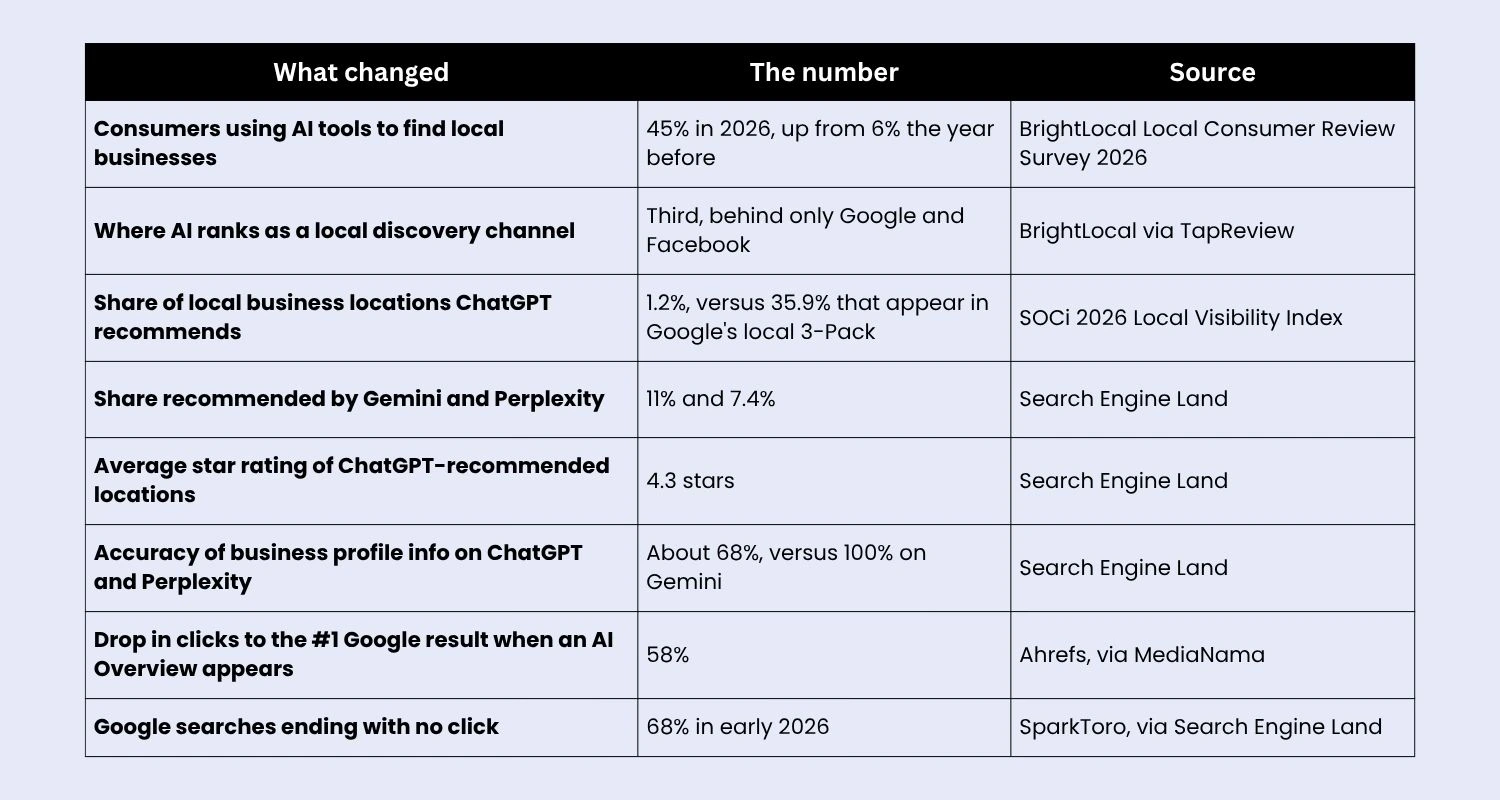
Sources: BrightLocal Local Consumer Review Survey 2026 (https://www.digitalapplied.com/blog/online-review-statistics-2026-consumer-trust-data and https://www.usetapreview.com/blog/brightlocal-2026-consumer-review-survey-star-ratings); SOCi 2026 Local Visibility Index via Search Engine Land (https://searchengineland.com/ai-local-visibility-report-2026-468085); Ahrefs via MediaNama (https://www.medianama.com/2026/02/223-google-ai-overviews-click-through-rates-58-study/); SparkToro via Search Engine Land (https://searchengineland.com/google-zero-click-searches-2026-study-479717)
Read those numbers together and the picture is clear. Nearly half your customers now ask AI for local recommendations. ChatGPT names roughly 1 in 80 local businesses when it answers. And when it does talk about a business, it gets basic facts like hours and phone numbers wrong about a third of the time.
Most teams miss this: ranking well on Google does not carry over automatically. SOCi found that strong traditional local search performance did not guarantee AI visibility. A business can sit in the map pack every day and still be invisible in ChatGPT.
The good news is that AI does not replace Google for local decisions. It front-loads them. BrightLocal found that most people who get an AI recommendation go to Google to verify it before they act. So AEO and local SEO feed each other. The AI builds the shortlist, and your Google presence closes the deal.
How answer engines decide which business to recommend
Every answer engine runs the same three operations before it names a business: retrieval, extraction, and ranking. If you fail at any one of them, you do not show up, no matter how good you are at the other two. This is the single most useful mental model for AEO, because it tells you exactly which lever to pull.
- Retrieval: can the engine find you? When someone asks a question, the AI searches a set of sources: its search index, Google Maps data, business directories, review sites, and your website. If your information is not in the places it looks, you are never considered. The lever: be present and consistent on the sources each engine relies on.
- Extraction: can the engine understand you? Once it finds a page, the AI pulls out specific facts: what you do, where you are, who you serve, what it costs, how you are rated. If those facts are buried in vague copy, locked in images, or contradict each other across sites, the AI cannot use them. The lever: state clear facts in plain language, structure pages around real questions, and add schema markup.
- Ranking: does the engine trust you enough to name you? With several candidates, the AI picks the ones with the strongest evidence: high ratings, recent reviews, consistent details, and independent sources that confirm you are real and good. The lever: build reviews and third-party corroboration.
The sources answer engines pull from are more controllable than most owners assume. A Yext study of 6.8 million AI citations found that 86% came from sources a business can manage or strongly influence: websites (44%), business listings (42%), and reviews and social (8%). General forums like Reddit made up only about 2%.
Each engine also has its own preferences, which is why one tactic rarely moves all of them:
.webp)
Sources: Yext research via Techstrong.ai and Search Engine Land.
AEO vs SEO: what is actually different?
AEO does not replace SEO. It sits on top of it. Google has said its AI features run on the same core search systems and signals as regular search, so a site that is hard to crawl or thin on content will struggle in both. What changes is the finish line.
.webp)
The practical takeaway: do not split your budget into "SEO" and "AEO" as if they compete. The foundation is shared. AEO is the layer that makes your foundation readable and quotable to machines that answer instead of list.
The local AEO system: 6 layers that get you named
Local AEO is a system, not a checklist of hacks. Each layer below maps to retrieval, extraction, or ranking. Build them in order, because each one makes the next one work harder.
Layer 1: Lock down your business identity (retrieval)
AI tools need to be certain your business is one real, specific entity. Inconsistent details create doubt, and doubt gets you filtered out before you are ever considered.
- Use the exact same business name, address, phone number, website, and hours everywhere. "Suite 200" on one site and "#200" on another is fine. A different phone number is not.
- Complete every field of your Google Business Profile: primary and secondary categories, services with descriptions, service area, attributes, hours, holiday hours, photos, and a description that states what you do and where.
- Claim and match your profiles on Bing Places, Apple Business Connect, Yelp, Facebook, the Better Business Bureau, and the top directories in your industry. ChatGPT pulls heavily from listings, so these are not optional.
Layer 2: Make sure AI can actually read your site (retrieval)
If a crawler cannot reach your content, nothing else matters.
- Check your robots.txt file and confirm you are not blocking Googlebot, Bingbot, OAI-SearchBot (ChatGPT search), or PerplexityBot.
- Put important information in real text on the page, not inside images, PDFs, sliders, or pop-ups.
- Keep pages fast and mobile-friendly. This is classic technical SEO, and it is still the foundation.
Layer 3: Build answer-first pages (extraction)
Answer engines pull passages, not whole pages. Write so any section can be lifted out and still make sense.
- Create one page per service and one page per city or area you serve. A single "Services" page that lists everything gives the AI nothing specific to quote.
- Use real customer questions as headings: "How much does a roof replacement cost in Park City?" beats "Our Roofing Solutions."
- Answer the question in the first one or two sentences under each heading, then add detail. Lead with the fact.
- Include the specifics people actually ask about: price ranges, timelines, service area, what is included, who it is for, and what makes you different. Vague copy cannot be extracted.
- Add a short FAQ to every service page with direct, two to four sentence answers.
Layer 4: Add structured data (extraction)
Schema markup is code that labels your facts so machines do not have to guess. It removes ambiguity about who you are and what you offer.
- LocalBusiness (use the most specific type, like Dentist, Plumber, or HomeAndConstructionBusiness) with your name, address, phone, hours, geo coordinates, and service area.
- sameAs links pointing to your Google Business Profile, Yelp, Facebook, and other official profiles. This ties your scattered listings into one identity.
- Service markup on each service page, and FAQPage markup on your FAQ sections.
- Only mark up what is visible on the page and true. Schema that contradicts your content hurts trust.
Layer 5: Run a review engine, not a review request (ranking)
Reviews are no longer just social proof. They are a filter. Locations ChatGPT recommends average 4.3 stars, and 31% of consumers won't use a business below 4.5 stars.
- Ask every happy customer, every time, through a simple text or email link. Build it into your process, not your memory.
- Prioritize recency. 74% of consumers look for reviews from the last three months, and AI tools read recency the same way.
- Ask customers to mention the specific service and the city. A review that says "they replaced our water heater in Midway same day" gives the AI extractable proof.
- Respond to every review, positive and negative. 80% of consumers say they are more likely to use a business that does.
Layer 6: Get other people to confirm you exist (ranking)
Answer engines trust what independent sources say about you more than what you say about yourself.
- Earn mentions in local news, community blogs, chamber of commerce directories, and "best of" lists in your town.
- Sponsor local events, teams, or nonprofits that list their sponsors with a link.
- Get listed on partner and supplier websites, and in industry associations.
- Contribute expert answers to local publications, podcasts, and community groups.
A note for bilingual markets: if you serve Spanish-speaking customers, they are asking AI tools questions in Spanish. A Spanish service page with the same specifics as your English one gives answer engines something to retrieve for those queries, and very few local competitors have one.
How to measure AEO
You measure AEO by tracking how often you are named in AI answers for the questions your customers actually ask, and whether what the AI says about you is correct. Traffic alone will undercount it, because many AI-driven customers never click. They read the answer, then search your name or call.
The 20-minute manual test
Any owner can run this today, no tools required.
- Write down 10 questions a customer would ask before hiring you. Mix them up: "best [service] in [city]," "who does [specific job] near [town]," "how much does [service] cost in [area]," and "is [your business name] good?"
- Ask each question in ChatGPT, Google (check the AI Overview), Gemini, and Perplexity. Use a private or logged-out window so your history does not skew results.
- For each answer, record three things: Were you named? Who was named instead? Was anything about you wrong (hours, phone, services, location)?
- Repeat the same questions monthly. AI answers vary from run to run, so the trend over time matters more than any single result.
The metrics that matter
.webp)
AEO myths that waste local businesses' money
The AEO space is full of confident advice with no evidence behind it. Here is what the data actually says.
Myth: An llms.txt file will get you into ChatGPT. An llms.txt file is a plain text summary of your site meant for AI tools. It is harmless and quick to add, but SE Ranking's study of about 300,000 domains found no measurable link between having one and getting cited, and Google states its search does not use the file. Treat it as housekeeping, not strategy.
Myth: You need special "AI pages" or markdown copies of your site. Search Engine Land reported that across roughly 18,000 citations, duplicate markdown pages earned none. Answer engines cite the same pages humans read. Make those pages better.
Myth: AEO means you can stop doing SEO. Google AI Overviews and Gemini are built on Google's index and Maps data. If your local SEO is weak, your AEO is weak.
Myth: Reddit and forums are the main thing AI reads. For local questions, forums were about 2% of citations in Yext's study. Your website, listings, and reviews do most of the work.
Myth: Pumping out AI-written blog posts will get you cited. Generic content that repeats what every other site says gives an answer engine no reason to choose you. Specific, first-hand information does: real prices, real timelines, real local detail, and real customer outcomes.
Myth: Once you are in, you stay in. AI answers change from week to week as models update and competitors improve. AEO is maintained, not finished.
Operator observation: where local businesses actually lose
When we audit local businesses for AI visibility, the problem is almost never that the business is bad. It is that the AI cannot prove the business is good. The pattern repeats: a strong Google rating, a website with one generic services page, a phone number that changed two years ago and still lives on three directories, and zero mentions anywhere outside their own channels. Each gap is small. Together they make the business look uncertain, and answer engines do not recommend uncertain businesses.
The fix is rarely expensive. It is unglamorous, consistent work done in the right order.
A 30-day AEO starter plan
Week 1: Baseline and identity
- Run the 20-minute manual test on 10 customer questions and save the results
- Audit your name, address, phone, and hours across Google, Bing, Apple, Yelp, Facebook, and your top industry directory
- Fix every inconsistency you find
- Complete every field in your Google Business Profile
Week 2: Site access and structure
- Check robots.txt for blocked AI and search crawlers
- Split your services into individual pages if they share one page
- Rewrite headings on your top three service pages as customer questions, with the answer in the first sentence
Week 3: Facts and schema
- Add price ranges, timelines, and service areas to your top service pages
- Add a short FAQ to each of those pages
- Add LocalBusiness, Service, and FAQPage schema, with sameAs links to your profiles
Week 4: Trust and corroboration
- Set up an automatic review request after every completed job
- Respond to every review from the last 90 days
- Pitch one local publication, chamber listing, or partner site for a mention
- Re-run the manual test and compare against week 1
Frequently asked questions about answer engine optimization
What is answer engine optimization in simple terms?
Answer engine optimization (AEO) is making your business easy for AI tools like ChatGPT, Google AI Overviews, Gemini, and Perplexity to find, understand, and recommend. Instead of competing for a spot in a list of links, you are competing to be named inside the answer.
Is AEO the same as SEO?
No, but they share a foundation. SEO helps you rank in traditional search results. AEO helps you get named and cited in AI-generated answers. Strong local SEO makes AEO easier, but ranking on Google does not guarantee AI tools will recommend you.
Do local businesses really need AEO?
Yes. BrightLocal's 2026 survey found 45% of consumers now use AI tools to find local businesses, up from 6% a year earlier. AI tools also recommend far fewer businesses than Google's map results, so the competition for those few spots is real.
How long does AEO take to work?
Fixes to listings and your Google Business Profile can show up in AI answers within weeks, especially on Gemini and Google AI Overviews. Content, reviews, and third-party mentions build over three to six months. Track your results monthly, because AI answers vary from run to run.
How do I know if ChatGPT recommends my business?
Ask it. Open a private browser window, ask ChatGPT the questions your customers would ask, like "best [your service] in [your city]," and note whether you are named and whether the details are accurate. Repeat monthly with the same questions to track progress.
What is the most important AEO factor for a local business?
Consistent, accurate business information across your Google Business Profile, website, and major directories. If AI tools cannot confirm who you are, nothing else you do will get you recommended. Reviews and third-party mentions are the next most important factors.
Does schema markup help with AEO?
Schema markup helps AI tools understand your business facts without guessing, such as your services, location, hours, and FAQs. It is not a shortcut on its own, but it supports the clear, consistent information answer engines rely on.
Do I need an llms.txt file?
It will not hurt, but current research shows no measurable link between having an llms.txt file and getting cited by AI tools, and Google says its search does not use it. Your time is better spent on listings, reviews, and answer-first service pages.
The bottom line
The businesses that win local search over the next few years will not be the ones with the biggest ad budgets. They will be the ones AI can describe with confidence. That comes down to three questions: Can the engine find you? Can it understand you? Does it trust you enough to say your name?
Most of your competitors have not asked those questions yet. That is the opening.
Want to know where you stand? JG Collective runs AI visibility audits for local businesses in Utah, in English and Spanish. We test the questions your customers are asking, show you who AI recommends instead of you, and map the fixes in priority order. Request your AEO audit.

.jpg)
.webp)
.webp)
