
.svg)
.svg)
What we'd do if it were our money
20 Queries Every Local Business Should Test in ChatGPT Right Now
Your customers are asking AI engines the questions they used to type into Google. The difference is that Google gave them ten links and let them decide. ChatGPT gives them one paragraph naming two or three businesses, and if you are not in it, you were never in the running.
Most local businesses have never checked. They assume that ranking on Google means showing up in AI answers, and it does not. Being retrieved and being named are separate outcomes, and you can score well on one while scoring zero on the other.
This is the diagnostic. Twenty copy-paste queries, what a good answer looks like for each, and what a bad answer actually means. It takes about thirty minutes and costs nothing. JG Collective runs this exact set as the first step of any AI visibility audit, and you can run it yourself before you spend a dollar with anyone.
How to run the test
- Open ChatGPT in a logged-out or temporary chat. Your history biases the results, and you want to see what a stranger sees.
- Replace the bracketed placeholders with your details.
[service]is what you sell,[city]is your primary market,[business name]is you. - Paste the query exactly. Do not clean it up or make it sound smarter. Test the phrasing customers actually use.
- For each answer, record three things: were you named in the answer text, was your URL in the sources, and what position were you in if you appeared in a list.
- Repeat the same twenty in Perplexity, Google AI Overviews, and Microsoft Copilot. They behave differently, and one number across all four averages away the signal.
Track it in a simple sheet. Query, platform, named yes or no, cited yes or no, position. That sheet is worth more than any dashboard you could buy.
The 20 queries
Discovery queries: can they find you at all?
1. Best [service] in [city]
2. Who are the top [service providers] in [city]?
3. I need a [service] in [city]. Who should I call?
4. [service] near [neighborhood or landmark]
5. Recommend a [service] in [county] County
What a good answer looks like: your business name appears in the answer text, ideally in the first three named. The answer describes you accurately.
What a bad answer means: if no local businesses are named at all and you get generic advice about how to choose a provider, the whole category is under-covered and there is an opening. If competitors are named and you are not, you have a specific, fixable gap.
Qualifier queries: do they know what makes you different?
6. [service] in [city] that [your differentiator] Example: "dentist in Heber City that offers sedation"
7. Spanish speaking [service] in [city]
8. Affordable [service] in [city]
9. Best [service] in [city] for [customer type] Example: "best contractor in Park City for historic home renovations"
10. [service] in [city] open on weekends
What a good answer looks like: you are named specifically because of the qualifier, not incidentally. The model connects your business to the attribute.
What a bad answer means: if you offer the thing and are not named, the attribute is not attached to your entity anywhere the model can see it. This is usually a Google Business Profile services field problem or a website copy problem, and both are cheap to fix.
Direct entity queries: does the model know you exist?
11. What is [business name]?
12. Tell me about [business name] in [city]
13. Is [business name] a good [service provider]?
14. What services does [business name] offer?
15. How much does [business name] charge?
What a good answer looks like: an accurate description, correct services, correct location, no invented details.
What a bad answer means: three failure modes here, and they are very different problems.
- "I don't have information about that business." Entity resolution failure. The model does not know you exist as a distinct thing. This is the most serious result on the whole test.
- Confusing you with another business. Name collision or inconsistent listings across directories.
- Confidently wrong details. Stale or conflicting information is out there and the model is averaging it. Find the source and fix it.
Comparison queries: how do you stack up when named alongside competitors?
16. [business name] vs [competitor name]
17. What's the difference between [business name] and other [service providers] in [city]?
18. Alternatives to [competitor name] in [city]
What a good answer looks like: you appear in the alternatives list for your competitors. Query 18 is the sleeper on this entire list, because it catches customers who have already decided to buy and are shopping around.
What a bad answer means: if your competitor has an alternatives list and you are not on it, they have third-party corroboration you do not. That is a placements problem, not a website problem.
Buying-intent queries: are you there at the moment of decision?
19. How much does [service] cost in [city]?
20. What should I look for when hiring a [service provider] in [city]?
What a good answer looks like: your business or your content is cited as a source, even if the answer is generic advice. These queries are where educational content earns attribution.
What a bad answer means: if the answer cites a national blog with no local relevance, there is no local authority on this question and the slot is unclaimed. Write the local version and take it.
Reading your results
Once you have all twenty across four platforms, the pattern matters more than any single answer.
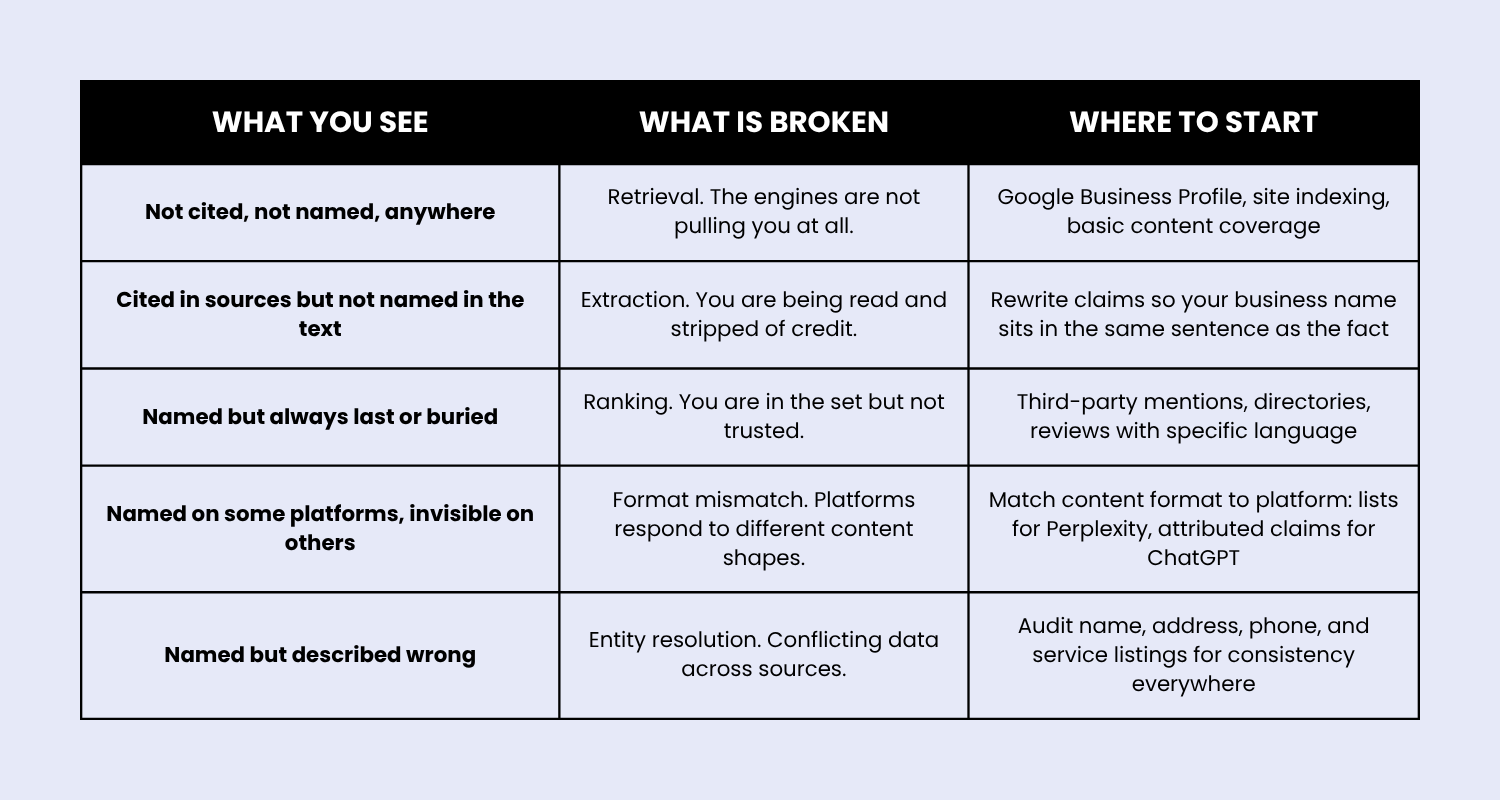
The cited-but-not-named gap is where most local businesses are actually losing, and it is invisible on every standard marketing dashboard. Your traffic report will not show it. Your rankings report will not show it. You only see it by running this test.
What to do first
Do not try to fix everything at once. In order of leverage:
- Fix any "I don't have information about that business" result immediately. Nothing else matters if the model does not know you exist.
- Fix wrong details next. Bad information spreads and compounds.
- Then work on extraction. Rewrite your key facts so your business name and the claim share a sentence.
- Then chase the qualifier gaps from queries 6 through 10, since those are the highest-intent misses.
- Only then worry about position. Being named seventh is a real problem, but it is a much later problem than not being named at all.
Run it again in 90 days
One test is a snapshot. The value is in the trend.
Save your sheet, put a reminder on the calendar, and rerun the same twenty queries in the same way. What you are watching for is not just your own movement but competitor movement, because a competitor gaining ground on one query cluster shows up here months before it shows up in your revenue.
The reality is that AI answer engines are observable systems, not black boxes. Most teams miss this because nobody told them they were allowed to just check. Thirty minutes and a spreadsheet gets you further than most of what gets sold as an AI visibility audit.

.webp)
.webp)