
.svg)
.svg)
.jpg)
What we'd do if it were our money
AEO vs GEO: What's the Difference?
Answer engine optimization (AEO) is the practice of getting your business chosen as the answer when someone asks a question, across AI tools, featured snippets, and voice assistants. Generative engine optimization (GEO) is the narrower practice of getting your content cited inside answers that AI models write, like ChatGPT, Perplexity, and Google AI Overviews. In practice, the two overlap so heavily that for a local business they are one job with two names.
The reality is that the AEO vs GEO debate matters a lot more to agencies selling services than to the businesses buying them. New acronyms make old work sound new. But underneath the labels, the question that decides whether you get recommended has not changed: can the machine find you, understand you, and trust you enough to say your name?
This guide breaks down where each term came from, what the research says actually works, where the two genuinely differ, and how to spend your budget without paying twice for the same work.
What AEO and GEO mean, and where each term came from
The two terms come from different eras of search, which explains most of the confusion.
Answer engine optimization (AEO)
AEO grew out of the featured snippet and voice search era of the late 2010s, when Google started answering questions directly at the top of results and assistants like Siri and Alexa started reading one answer out loud. The goal was simple: be the single answer, not one of ten blue links.
As AI tools arrived, the term stretched to cover them too. Today AEO describes optimizing for any system that answers instead of lists: Google AI Overviews and AI Mode, ChatGPT, Gemini, Perplexity, featured snippets, knowledge panels, and voice assistants.
Generative engine optimization (GEO)
GEO is younger and has a specific origin. It was coined in a research paper, "GEO: Generative Engine Optimization," by researchers from Princeton University, IIT Delhi, and collaborators, first published in late 2023 and presented at the KDD 2024 data mining conference. The paper defined a generative engine as a system that retrieves sources and then writes a new answer with a large language model, citing some of those sources along the way.
GEO focuses on one outcome: getting your content selected, quoted, and cited when an AI model writes its answer.
The other names you will see
- LLMO (large language model optimization) and AIO (AI optimization) describe the same territory as GEO.
- AI SEO or AI search optimization is the umbrella term many marketers use for all of it.
- SEO remains the foundation underneath every one of them, because most AI tools retrieve from traditional search indexes before they answer.
AEO vs GEO side by side
The cleanest way to see the difference: AEO is defined by the outcome (be the answer), GEO is defined by the technology (be a source the AI writes from).
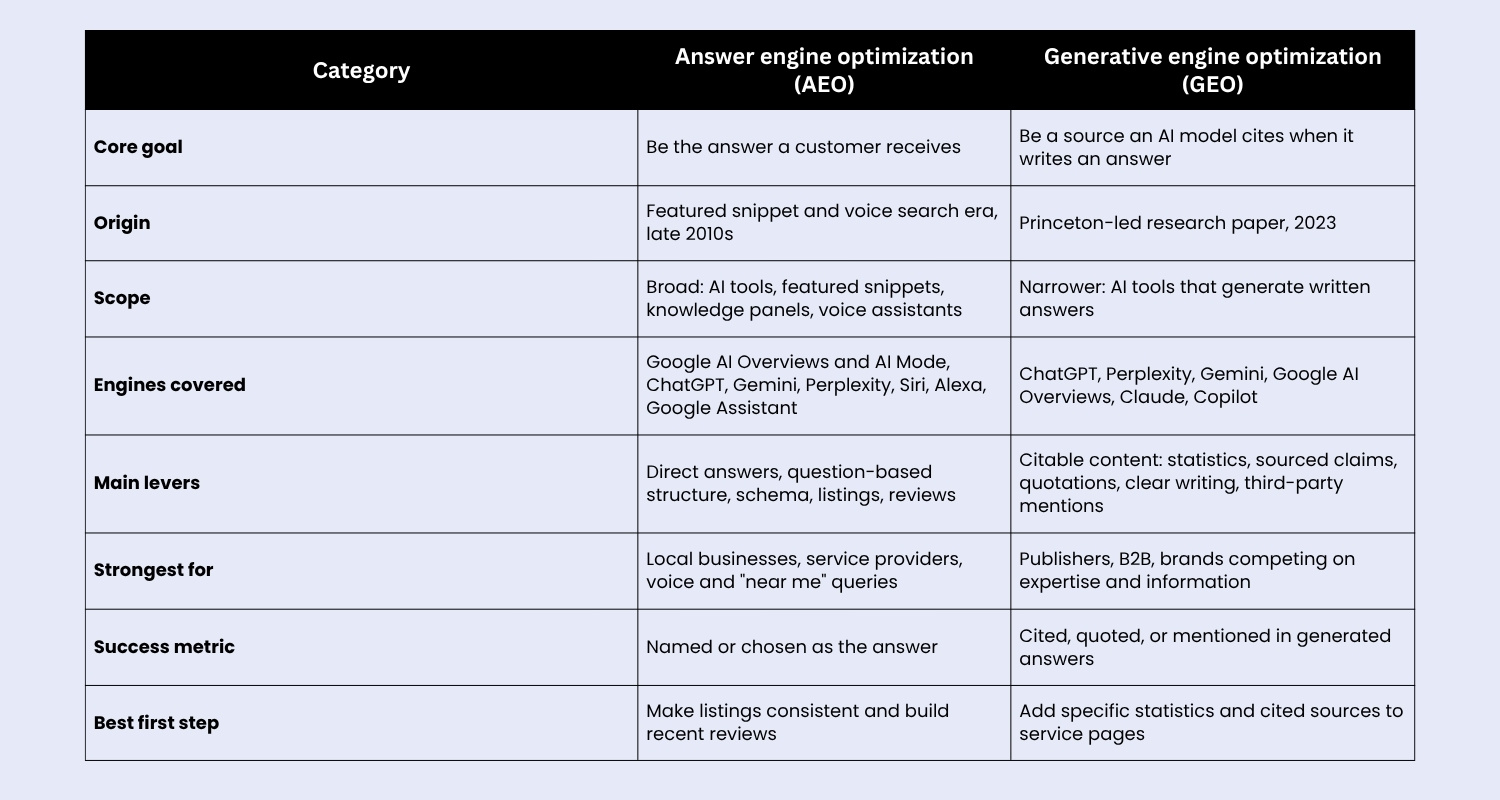
Most teams miss this: for a local business, the line nearly disappears. When someone asks ChatGPT for the best HVAC company in Park City, the AI is generating an answer (GEO territory) to a question that needs one recommendation (AEO territory). The same listings, reviews, and pages win both.
What the research says actually works
Both disciplines now have real data behind them. Read together, the studies point to the same conclusion: AI rewards specific, verifiable, consistent information.
The GEO research: give the AI something worth citing
The original GEO paper tested content changes on roughly 10,000 queries and measured how often the edited pages showed up in AI-written answers. The findings:
- Specific content changes boosted a source's visibility in generative engine responses by up to 40%.
- The strongest changes were adding statistics, adding quotations from credible sources, and citing sources inside the content.
- On Perplexity, a live AI search engine, the same methods improved visibility by up to 37%.
- What worked depended on the topic. No single tactic won in every category.
- Old-school keyword stuffing, the most common SEO shortcut, was among the weakest methods tested.
The takeaway for business owners: vague marketing copy ("we offer top-quality service") gives an AI nothing to quote. A sentence like "we complete most water heater replacements in Heber City within 24 hours" does.
The AEO research: be findable and trustworthy where answers are built
For local questions, the data points to listings, reviews, and owned pages:
- A Yext study of 6.8 million AI citations found 86% came from sources a business can manage: websites (44%), listings (42%), and reviews and social (8%).
- SOCi's 2026 Local Visibility Index found ChatGPT recommended just 1.2% of local business locations, and the ones it did recommend averaged 4.3 stars.
- The same study found strong Google map rankings did not guarantee AI visibility.
GEO research tells you how to write. AEO research tells you where to show up. A business that only does one of them leaves half the system unbuilt.
Where AEO and GEO overlap: one system, not two budgets
Every AI answer is built in three operations: retrieval (finding candidate sources), extraction (pulling facts and passages out of them), and ranking (deciding which to trust and name). AEO and GEO are simply two lenses on the same three operations, each with a different emphasis.
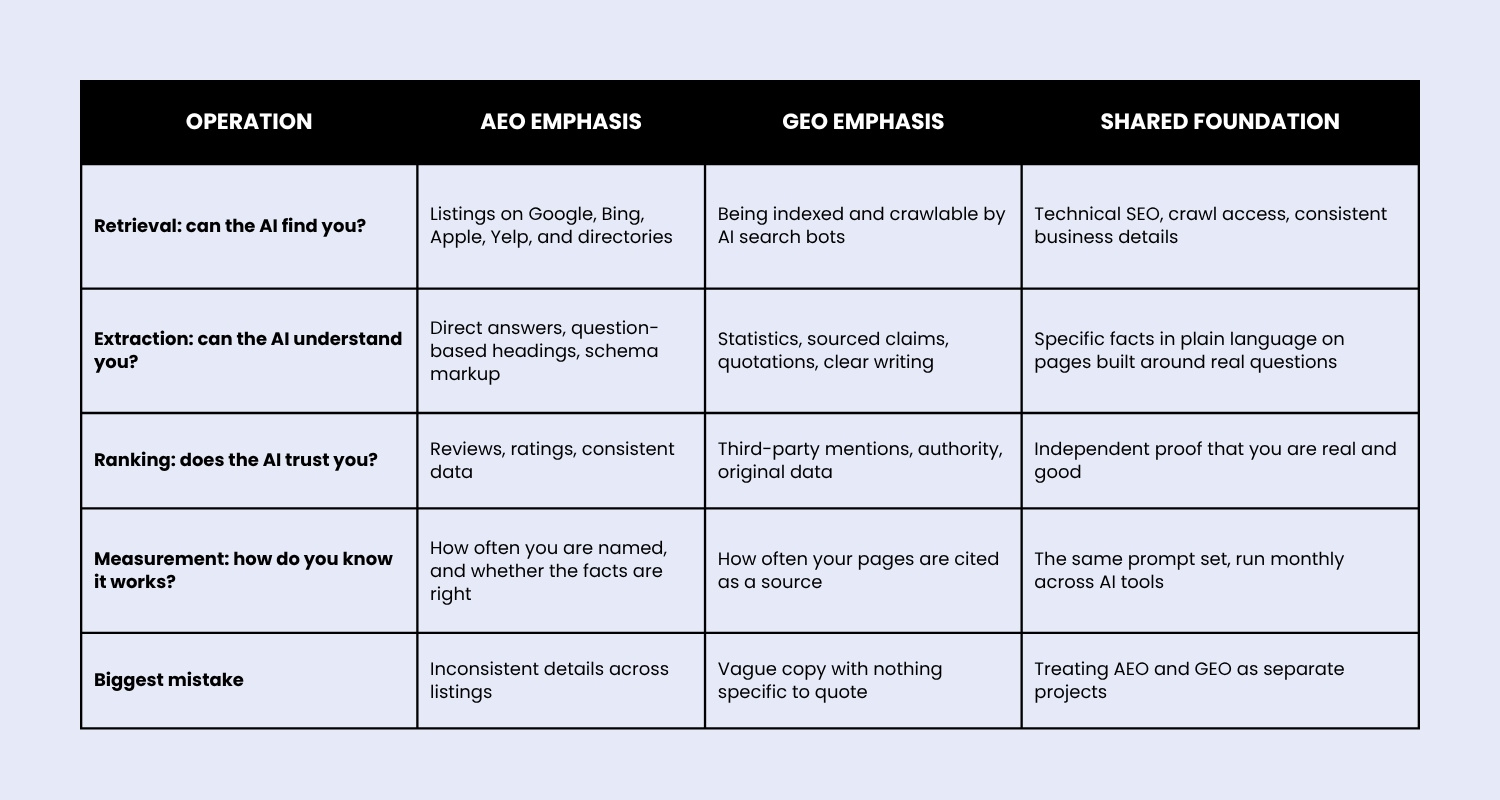
Read the table top to bottom and the conclusion is hard to miss. There is no AEO task that hurts GEO, and no GEO task that hurts AEO. Splitting them into separate projects with separate vendors mostly creates duplicate audits and duplicate invoices.
The one real difference is where you start. If your business depends on local, "near me," or voice questions, start with the AEO emphasis: listings, reviews, and answer-first service pages. If you compete on expertise, start with the GEO emphasis: original data, sourced content, and getting cited by publications in your field.
What this means for local businesses: the combined playbook
For a local business, the smart move is to run AEO and GEO as one program built in this order. Each step serves both disciplines.
- Make your business details identical everywhere. Name, address, phone, website, and hours across Google Business Profile, Bing Places, Apple Business Connect, Yelp, Facebook, and industry directories. (Retrieval for both.)
- Let the right crawlers in. Confirm robots.txt allows Googlebot, Bingbot, OAI-SearchBot, and PerplexityBot. (Retrieval for both.)
- Build one page per service and per area. Lead every section with a direct answer to a real customer question. (AEO extraction.)
- Load those pages with citable specifics. Price ranges, timelines, service areas, process steps, and local statistics. Cite sources when you use outside data. (GEO extraction, straight from the research.)
- Add LocalBusiness, Service, and FAQPage schema with sameAs links to your profiles. (Extraction for both.)
- Run a review engine. Ask every customer, prioritize recent reviews, and respond to all of them. (AEO ranking.)
- Earn third-party mentions. Local news, chamber listings, partner sites, and "best of" roundups. (Ranking for both.)
- Publish one original data point a quarter. A local price survey, a seasonal demand trend, or a customer stat only you have. Original data is the most citable content there is. (GEO ranking.)
If you serve Spanish-speaking customers, mirror steps 3 and 4 in Spanish. AI tools answer Spanish questions from Spanish sources, and very few local competitors have built them.
For how to measure whether any of this is working, see How to Check Whether Your Business Shows Up in ChatGPT.
How to vet an agency selling AEO or GEO
The label on the proposal matters far less than what the agency will actually do and how they will prove it worked. Yes, we are an agency too. These are the questions we would want a client to ask us.
Ask these questions:
- How will you measure my visibility before you start? (A real answer involves a fixed set of customer prompts, run multiple times across several AI tools.)
- Which of my listings, pages, and reviews will you change in the first 30 days?
- What will you report monthly, and how does it tie to calls, bookings, or revenue?
- How do AEO and GEO fit together in your plan? (A good answer: they are the same system.)
Watch for these red flags:
- Guaranteed placement. No one can guarantee ChatGPT will recommend you. AI answers change from run to run.
- An "AI ranking position" as the main metric. SparkToro found AI tools return the same recommendation list less than 1 in 100 times. Position is noise; how often you appear is the signal.
- llms.txt as the centerpiece. Research on about 300,000 domains found no measurable link between the file and AI citations.
- Separate AEO and GEO retainers. You would be paying twice for overlapping work.
- No mention of reviews or listings. For local businesses, those drive a large share of what AI tools cite.
Frequently asked questions
What is the difference between answer engine optimization and generative engine optimization?
Answer engine optimization (AEO) focuses on getting your business chosen as the answer across AI tools, featured snippets, and voice assistants. Generative engine optimization (GEO) focuses specifically on getting your content cited when AI models like ChatGPT and Perplexity write their answers. AEO is broader; GEO is a subset focused on AI-generated responses.
Is GEO replacing AEO?
No. The terms describe overlapping work, and both are used widely in 2026. GEO is more common among content and B2B marketers, while AEO is more common in local and voice search. The tactics that work are largely the same.
Is GEO the same as SEO?
No, but GEO depends on SEO. Most AI tools retrieve sources from traditional search indexes before writing an answer, so a site that is not crawlable or indexed cannot be cited. GEO adds a layer focused on making content quotable and trustworthy to AI models.
Where did the term generative engine optimization come from?
The term was introduced in a 2023 research paper, "GEO: Generative Engine Optimization," by researchers from Princeton University, IIT Delhi, and collaborators, presented at the KDD 2024 conference. The paper found that adding statistics, quotations, and source citations could boost visibility in AI-generated answers by up to 40%.
Should a local business focus on AEO or GEO?
A local business should treat them as one program, starting with the AEO side: consistent listings, reviews, and service pages that answer customer questions directly. Then add GEO tactics like specific statistics, cited sources, and original local data to make that content more quotable.
Do I need separate agencies for AEO and GEO?
No. The work overlaps almost completely: the same listings, pages, schema, reviews, and third-party mentions drive both. One integrated program is more efficient than two separate retainers.
The bottom line
AEO and GEO are two names for one shift: customers now get answers instead of lists. The businesses that win will not be the ones that picked the right acronym. They will be the ones that made themselves easy to find, easy to quote, and easy to trust, in every place an answer gets built.
Stop asking which one you need. Ask which part of the system you are missing.
Not sure where your gaps are? JG Collective runs AI visibility audits for local businesses in Utah, in English and Spanish. We test the questions your customers ask, show you who AI tools recommend instead of you, and build one plan that covers AEO and GEO together. Request your audit.