
.svg)
.svg)
What we'd do if it were our money
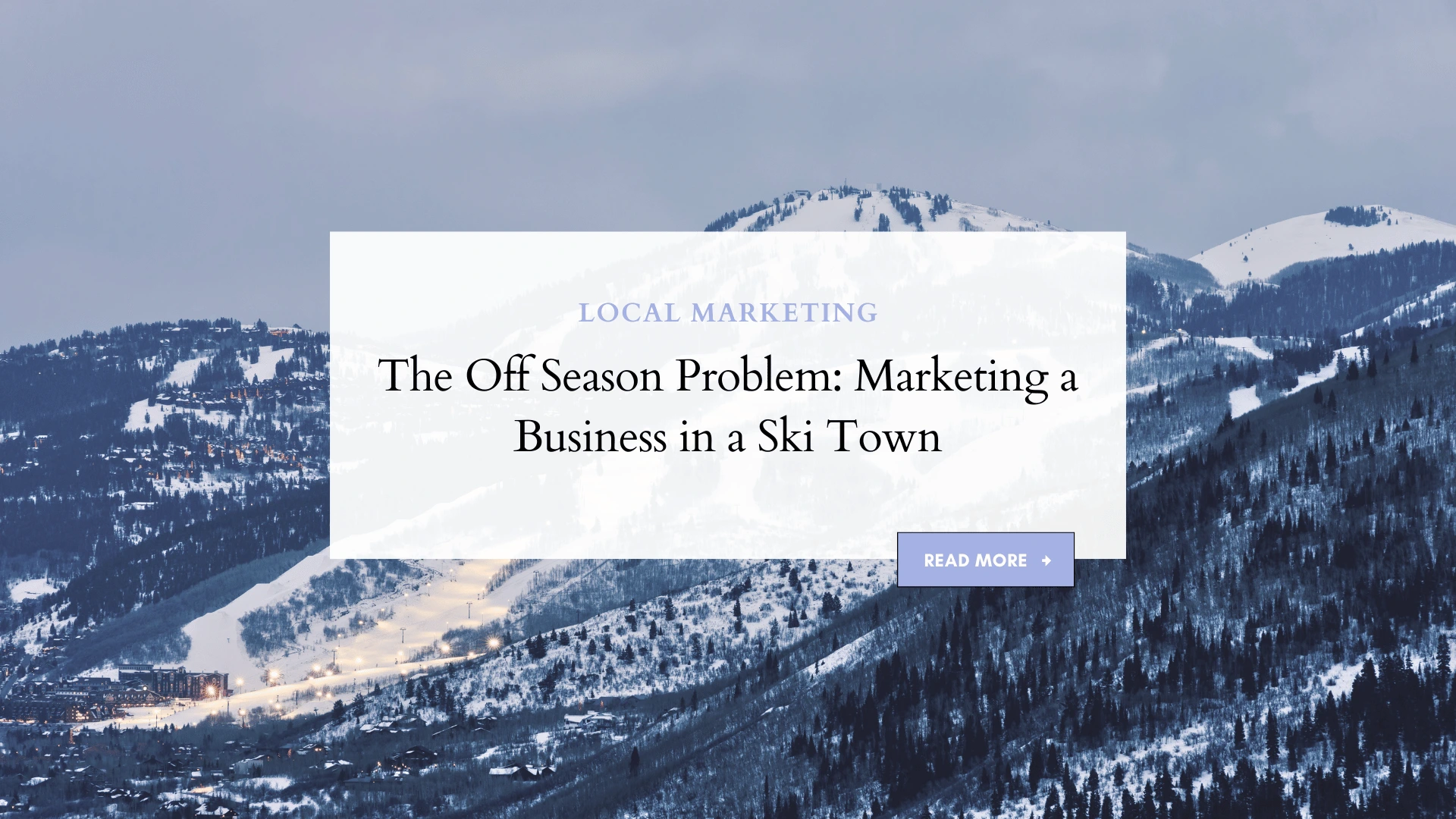
The Off Season Problem: Marketing a Business in a Ski Town
In March 2026, Park City area lodging ran at 52.3% occupancy with an average nightly rate of $964.30. In April, occupancy dropped to 14.3% and the average rate fell to $390. One month apart. Roughly a quarter of the demand at 40% of the price.
That cliff is the defining fact of running a business here, and almost every off-season strategy gets it backwards. When revenue falls, marketing is the first line cut, which means the businesses that need demand most are the ones that stop generating it.
The reality is that the off season is not a revenue problem you solve in April. It is a capture problem you solve in February, when the town is full of people you will never see again unless you collect them.
Below is what the data says, and then fourteen specific plays, including the mechanics of running them and what each one actually moves.
The numbers behind the cliff
The 2025 to 2026 winter was unusually weak. A late start to snow, inconsistent conditions, and early resort closures pulled the season short, with Deer Valley closing March 29 and Park City Mountain closing in April. March occupancy fell 24.4% year over year and April was pacing down another 22.5%.
The ripple through the local economy was immediate and much wider than lodging. Park City reported that March sales tax collections dropped 19.9% compared to the previous March, and came in 18.9% under budget.
Then May turned. Occupancy rose 22% over the prior year, partly because the snow melted early and people started biking and hiking sooner. The Chamber's group sales team spent the spring working specifically to fill rooms from May through October and November.
Three things worth pulling out of that:
- The swing is fast and not fully within your control. Snow decides a meaningful share of your revenue.
- The whole local economy moves together. When lodging softens, restaurants, retail, and services soften in the same month.
- The recovery came from a different audience than the one that left. Bikers, hikers, and groups are not skiers.
Your customer changes. Your marketing usually doesn't.
Most seasonal businesses run one marketing program all year and simply do less of it when things get slow. That is the core error. The off season is not the same audience buying less. It is a different audience entirely.
Broadly there are four, and each one has a different acquisition cost and a different season:
- The destination visitor. High spend, low frequency, plans months ahead, gone by mid-April. Expensive to reach, and reached largely through channels you do not control.
- The regional day tripper. Salt Lake, Davis, and Utah County, roughly 35 to 60 minutes away. Decides late, price sensitive, available all year, and cheap to reach because they are close enough for geo-targeted ads to make sense.
- The second homeowner. Here in bursts, spends like a visitor, behaves like a local, and is almost never marketed to deliberately.
- The full-time local. Park City, Heber, Midway, Kamas. Lower ticket, far higher frequency, and the only group that is here in April.
Off-season revenue comes almost entirely from the last three. Peak revenue comes almost entirely from the first. Running the same message to all four, all year, means you are speaking mostly to an audience that has already left the county.
The three levers you actually have
In the off season you cannot conjure visitors. What you can change breaks into three levers, and it helps to be honest about which one you are pulling:
- Customers. New people through the door. Hardest and slowest in the trough, and the most expensive per unit.
- Frequency. How often the people already here come back. This is the highest-leverage lever in a small town, because the local population is finite but their visit count is not.
- Average ticket. What each visit is worth. Underused, and it does not require a single new customer.
Most off-season plans reach straight for lever one, which is the only one that barely moves in April. The plays below are weighted toward two and three on purpose.
Why April is the wrong month to start
Search demand runs ahead of visits. People research and book winter trips in the fall, and they research summer trips in the spring. Anything you do to improve search visibility takes roughly 90 to 180 days to move meaningfully. Work done in April affects August. Work done in September affects the holidays.
So the marketing you do in your slow months is not for your slow months. It is for the peak that follows. And the capture work you do in your busy months is what fills the slow ones. Both are counter-intuitive, which is exactly why the sequence gets reversed.
There is data behind the cost of going dark. In The CMO Survey's 2026 edition, marketing leaders put the median durability of a marketing investment's effect at about six months. Switching spending off for a quarter does not pause your results. It resets them, and you pay the ramp-up again right as the season starts.
Fourteen plays that move the numbers
1. Turn every peak transaction into a contact.This is the single highest-value thing you do all year, and it happens in your busiest month, which is why it never happens. Build one mechanism and make it the default: a QR code on the receipt, a WiFi login that asks for an email, a text-for-the-waitlist system that keeps the number afterward, or a printed card with a real reason attached.
The reason matters more than the mechanism. "Join our newsletter" converts terribly. "Text JOIN for 20% off your next visit and first access to locals nights" converts because there is something in it today.
Set a target you can actually check, like 30% of transactions producing a contact, and review it weekly during the season. What moves: your entire off-season addressable audience.
2. Front-load your review requests into the busy months.Reviews are one of the heaviest local ranking factors, and recency counts. Asking during peak gives you both volume and the freshness that keeps you visible in the trough, when a smaller number of searches carries much more weight per search. Build the ask into the moment of payment rather than into a follow-up email nobody opens.
What moves: search visibility three to six months out, which is precisely when you need it.
3. Photograph and film your entire year in eight weeks.Full dining room, packed shop, good light, real customers. You need twelve months of content and there is exactly one window where the place looks the way you want to sell it. Shooting in April produces empty-room photos that quietly communicate exactly what you are trying not to communicate.
Cash flow plays
4. Sell prepaid value in February that gets redeemed in April.This is the most underused play in a seasonal town, and it fixes two problems at once. A ten-visit card, a punch card, a prepaid balance with a bonus, or a service package sold at peak takes in cash while you have foot traffic, and it creates a redemption obligation that pulls people back during the months you are empty.
Structure it so the bonus is meaningful and the redemption window lands in the trough. Buy $200 in March, get $250 in credit, valid April through June. The customer feels like they won, you got the cash when you had the traffic, and you have manufactured April visits that would not have existed.
What moves: cash timing, off-season traffic, and frequency all at once.
5. Push gift cards to visitors during peak.Visitors buy gift cards for locals and for their next trip. Both outcomes help you. Put them at the register, mention them in the checkout flow, and price them so they are an easy yes.
6. Pre-sell next season during the trough.Discounted winter bookings, service contracts, or memberships sold in May at a rate that is genuinely better than the winter price. You get cash when you need it most, and locked-in demand when everyone else is competing for it.
Frequency plays, aimed at the local base
7. Build a locals program with real mechanics.Most locals discounts are a sign on the wall and 10% off, which changes nobody's behavior. A program that works has structure:
- Verified. Tied to residency, checked once at signup. Scarcity is the point.
- Day-restricted. Valid Tuesday through Thursday, not on weekends or holidays. You are filling capacity you were going to lose, not discounting demand you already had.
- Captured. Signup requires a phone number or email, which is the actual asset being built.
- Communicated. A text on a slow Tuesday morning, not a page on your website nobody visits.
Launch it in January when you have the traffic to enroll people, not in April when you need it.
What moves: frequency, and the size of the list you can activate on any given slow day.
8. Use SMS for last-minute local demand, not email.Local, same-day decisions run on text. A short message at 10:00 on a quiet Wednesday to a list of 800 locals will outperform any ad you can buy that day. Keep it rare enough to stay welcome, roughly two to four times a month, and always with a specific offer and an expiration.
9. Run a reactivation campaign to last off season's customers.Pull everyone who came in during last April and May and contact them directly in the first week of April. These are proven off-season customers, which is a category most businesses never bother to isolate. It is the cheapest revenue available to you all year.
Demand plays, aimed at bringing new people in
10. Target the Wasatch Front day tripper with drive time, not distance.Salt Lake and Utah County sit 35 to 60 minutes away and contain more people than will ever fly in. In shoulder months, run geo-targeted ads to those zip codes with a drive-time hook and a weekday reason to come up. This audience is dramatically cheaper to reach than destination visitors and they are available in exactly the months destination visitors are not.
Pair it with something time-bound. "Forty minutes from Salt Lake, Tuesday through Thursday in May" is a specific proposition. "Come visit us" is not.
11. Go get the second homeowner and the property manager.Second homeowners return on a predictable rhythm and almost nobody markets to them as a distinct group. Property managers, concierge services, and HOAs sit between you and hundreds of them. Build a referral relationship with two or three property managers, offer their guests something specific, and ask to be included in the welcome materials that land in every unit.
For service businesses, trades, and cleaning, this channel is often worth more than every ad you run.
12. Chase the demand that books in advance for dates nobody wants.Groups, weddings, corporate retreats, reunions, and nonprofit events all book months out and are actively looking for shoulder-season dates because they are cheaper. The Chamber's group sales team spent this spring specifically working to fill May through November. Make sure you are on their radar, submit your shoulder availability, and build one simple group package with pricing you can send the same day someone asks.
13. Partner with three complementary businesses on a shoulder bundle.A restaurant, a spa, and a shop can build a single April offer that none of them could fill alone, and each one markets it to a list the others do not have. Cheap to run, triples your reach, and the cross-referral usually outlasts the promotion.
The play that is really a mistake to avoid
14. Do not close the digital front door when you cut hours.Reducing hours in the off season is often correct. Failing to update them is not. Whether a business is open at the time of the search ranks fifth among local pack ranking factors in Whitespark's 2026 survey of 47 local search experts, and Google filters hard for businesses that are open right now.
So if you go to four days a week in April, update your Google Business Profile hours, your holiday hours, and every listing you have. Otherwise you are invisible during the exact hours you are open, in the exact month when every single search matters more.
While you are in there, keep posting, keep answering messages, and keep your photos current. It costs nothing and it is the difference between dormant and gone.
Plays by business type
Restaurants and bars. Prepaid dining cards sold in February. Locals nights Tuesday through Thursday. A fixed-price shoulder menu that protects margin instead of discounting the whole check. Private events and group bookings for May and October. Cut days rather than quality, and never cut the days your locals have learned to expect.
Retail. Gift cards during peak. Off-season clearance that targets locals rather than tourists, because the buyer is different. Online sales to visitors who came in during winter, which is the only real way to keep selling to someone who has gone home. Trunk shows and events that create a reason to visit on a specific date.
Lodging and short-term rentals. Weekday and long-stay pricing, since the shoulder guest is more flexible on dates than on price. Remote worker and midweek positioning. Group and wedding blocks. Direct booking incentives pushed to past guests, since a repeat direct booking is worth far more than a platform booking.
Home services and trades. Shoulder season is your best working window and everyone knows it, so sell it that way: book the April project in February at a rate that reflects the easier schedule. Maintenance agreements that create recurring visits. Property manager and HOA relationships that produce steady work independent of tourism.
Wellness, spa, and personal services. This is the clearest frequency play in town. Memberships and packages sold in peak and redeemed in the trough. Locals pricing on weekdays. Second homeowner arrival offers timed to when they come back.
The twelve month calendar
December through March, peak. Capture.Contact capture at every transaction. Review requests at volume. Photography and video. Enroll the locals program. Sell prepaid cards and gift cards. Do not launch new marketing initiatives, because you have no attention to give them.
April and May, shoulder. Activate and build.Text and email the list you built. Reactivate last year's off-season customers. Run day-tripper ads to the Wasatch Front. Redeem the prepaid cards you sold. Update hours everywhere. Do the website and search work that lands in time for summer.
June through August, second peak. Treat it as a real season.Different visitor, different message. Trails, festivals, weddings, family travel. This deserves its own positioning rather than a quieter version of your winter one, and it is the fastest-growing part of the year for most local businesses.
September through November, shoulder. Sell forward.This is when winter gets booked. Search work done now shows up in December. Pre-sell winter. Chase group business. Get your seasonal pages, hours, and offers live before the demand arrives, not after.
A note on which town you are in
Heber, Midway, and much of Wasatch County run on a flatter curve than Park City does. There is a larger permanent residential base, more year-round trade work, and less exposure to destination visitors. The same strategy applies but the ratios shift, and a business in Heber can usually build a genuinely year-round customer base rather than treating winter as the whole year.
Know your own curve before copying anyone else's calendar.
What to measure
Most teams miss this because they only look at the current month. Six things to track instead:
- Monthly revenue for the past three years, side by side. Your real seasonal shape, not the one you assume
- Percentage of revenue from local and regional customers versus destination visitors
- List growth per month. Peak months should be your biggest by a wide margin
- Redemption rate on prepaid cards and packages, and which month they land in
- Off-season revenue traceable to contacts captured during peak. This is the number that proves the whole strategy
- Visits per local customer per quarter, which is your frequency lever in a single number
If you do not know your local versus visitor split, find that out first. Every decision above depends on it.
Three things not to do
Do not discount into the trough. Broad discounting trains your best customers to wait for the sale and permanently resets what they expect to pay. Restrict offers by day, by residency, or by package instead, so you are filling empty capacity rather than repricing your whole business.
Do not go dark. Cutting marketing in April feels responsible and works out badly, because the spending you cut in April was buying December.
Do not fire the relationship. Staff cuts are sometimes unavoidable, but the person your regulars know is part of what brings them back. If you have to reduce hours, protect the days and faces your locals have organized their week around.
The bottom line
You cannot control the snow. You can control whether the thousands of people who came through your door in February are strangers again in April.
Every play above comes down to the same idea: peak season is when you harvest contacts, cash, and content, and the off season is when you spend them. Businesses that survive weak winters here are the ones with a list, a locals program, a prepaid balance sheet, and a reason for someone in Heber to come in on a Tuesday.
If you want help mapping your seasonal curve and building the capture side of it, JG Collective builds local SEO and marketing strategy systems for businesses across Park City, Heber, Midway, and the Wasatch Back, in English and Spanish. If budget is the question underneath this one, we broke that down in what a small business should actually spend on marketing.
Book a free 20 minute discovery call.
Sources: Park City Chamber and Visitors Bureau lodging data as reported by TownLift, KPCW, and the Park Record, April to June 2026. Park City municipal sales tax collections, March 2026. Whitespark Local Search Ranking Factors 2026. The CMO Survey, 35th edition, 2026.

.webp)
.webp)