
.svg)
.svg)
What we'd do if it were our money
How to Find Your Target Customer When You're a Small Business
The fastest way to find your target customer is to study the customers you already have. Look at who buys most often, spends the most, refers others, and is easiest to work with. The patterns you find there, in who they are, what problem they're solving, and where they found you, define your target customer.
The reality is most small businesses guess. They build marketing around who they think they serve instead of who actually pays them. The data is usually already sitting in their invoices, inbox, and reviews.
Quick answer: 5 steps to find your target customer
- List your best current customers by revenue, repeat business, and fit
- Find the patterns they share: who they are, where they are, and why they bought
- Talk to five of them about the problem they hired you to solve
- Map where they look for help: search, social, referrals, or local groups
- Write a one-page target customer profile and use it in every marketing decision
Why "everyone" is the wrong answer
Ask a small business owner who their customer is and you'll often hear "anyone who needs what we do." It feels safe. It's expensive.
When your marketing speaks to everyone, three things happen:
- Your message gets generic. "Quality service at a fair price" could describe any competitor in town.
- Your budget spreads thin. You pay to reach people who were never going to buy.
- Your best customers don't recognize themselves. People choose the business that sounds like it was built for them.
Narrowing your focus doesn't mean turning other customers away. It means your marketing is aimed at the people most likely to buy, return, and refer. Everyone else can still walk through the door.
Most teams miss this: a target customer isn't a marketing exercise. It's a revenue decision. It shapes what you say, where you show up, what you charge, and which leads you chase first.
The 5-step system to find your target customer
Step 1: Score the customers you already have
Pull a list of everyone who bought from you in the last 12 months. Your invoicing tool, POS, CRM, or even your email inbox will do. Then score each one on four things:
- Revenue: how much they spent
- Frequency: how often they came back
- Referrals: whether they sent others your way
- Fit: how easy and profitable they were to serve
Circle your top 10 to 20%. These are the customers you want more of. If you're brand new, use your first handful of customers plus the people who inquired but didn't buy yet.
Step 2: Find the patterns
Look at your top customers side by side. What do they have in common?
- Who they are: homeowners or renters, families or retirees, business type and size
- Where they are: neighborhood, city, or service area
- Language and culture: many Utah businesses serve English and Spanish speakers, and those audiences often find and choose businesses differently
- Trigger: what happened right before they called you (a move, a breakdown, a season, a deadline)
- Budget: what they were willing to pay, and what they pushed back on
You're looking for overlap, not perfection. Two or three strong patterns are enough to start.
Step 3: Talk to five of them
Data shows you who. Conversations show you why. Call or meet five top customers and ask:
- What was going on when you decided to look for help?
- What else did you consider before choosing us?
- Where did you look? (Google, Instagram, a friend, a Facebook group)
- What almost stopped you from buying?
- How would you describe what we do to a friend?
Write down their exact words. The language customers use to describe their problem is the language your marketing should use.
Step 4: Map where they look for help
Your target customer isn't everywhere. Find out where they actually spend attention when they need you:
- Searching Google or asking ChatGPT for a recommendation
- Scrolling Instagram, Facebook, or TikTok
- Asking in local Facebook groups or neighborhood apps
- Getting referrals from friends, family, or other businesses
This tells you which channels deserve your time and money, and which you can ignore.
Step 5: Write it down on one page
Turn everything into a one-page target customer profile. If it doesn't fit on a page, it's too broad. The template below shows what to include.
The one-page target customer profile
Here's the template, filled in for a fictional Wasatch Back landscaping company.
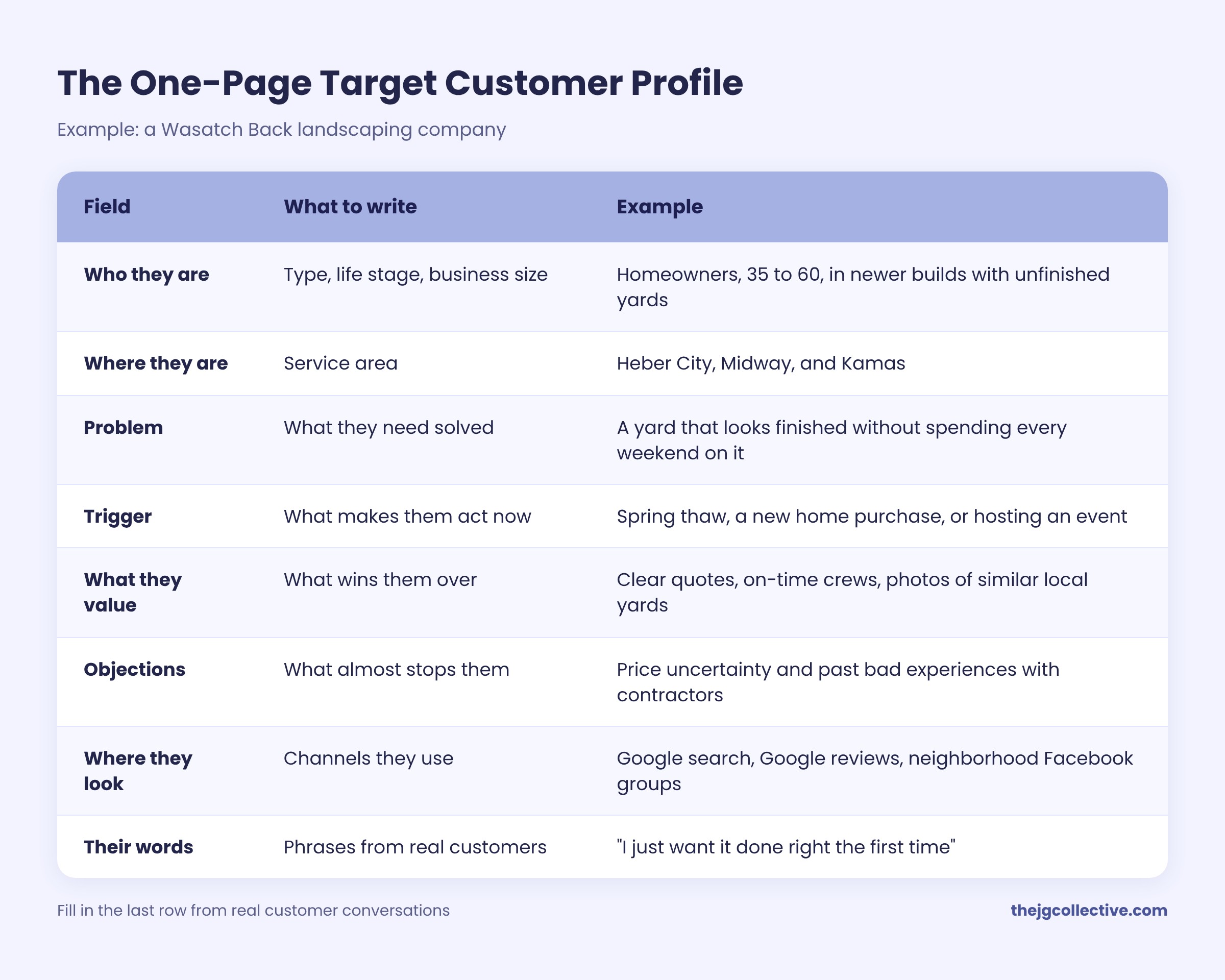
Use your own customer interviews for the last row. Real phrases beat polished copy every time.
How to put your target customer to work
A profile in a drawer does nothing. Use it as a filter for every marketing decision.
- Website: Rewrite your homepage headline around their problem, in their words.
- Channels: Spend time and budget only where Step 4 says they look.
- Content: Answer the questions they asked in your interviews. Those are the searches they run on Google and ChatGPT.
- Offers: Match pricing and packages to what they value and what worried them.
- Ads: Target by the location, life stage, and interests in the profile instead of broad audiences.
- Sales: Prioritize leads that match the profile. Follow up on them first.
How to know it's working
Track three numbers before and after you apply the profile for 90 days:
- Lead-to-customer conversion rate
- Average sale value
- Share of new customers who match the profile
If all three rise, your targeting is sharpening. If not, revisit Steps 2 and 3. Plan to update the profile at least once a year, or any time your best customers start to look different.
Common mistakes to avoid
- Building the profile from assumptions. Start with real customer data, not who you wish you served.
- Stopping at demographics. Age and income tell you who. The trigger and the problem tell you why they buy, which is what drives action.
- Creating five personas on day one. Start with one primary customer. Add a second only when the data clearly shows one.
- Choosing the biggest group instead of the best. Your most common customer isn't always your most profitable one.
- Ignoring language. In bilingual markets, an English-only message can miss a large share of your best customers.
- Writing it once and forgetting it. Customers, seasons, and markets change. Revisit the profile yearly.
Frequently asked questions
What is a target customer?
A target customer is the specific type of person or business most likely to buy from you, return, and refer others. Defining one helps a small business focus its message, channels, and budget on the people who drive revenue.
How do I find my target customer if I'm just starting out?
Start with your first few customers, the people who have inquired, and competitors' reviews. Look for shared problems and triggers, then test your messaging and refine the profile as real customers come in.
What's the difference between a target market and a target customer?
A target market is the broad group you serve, such as homeowners in Wasatch County. A target customer is a specific profile within it, including their problem, trigger, objections, and where they look for help.
How many target customers should a small business have?
Start with one primary target customer. Add a second profile only when your data shows a distinct, valuable group with different needs.
Does focusing on one target customer mean losing other customers?
No. A target customer guides where you spend marketing time and money. Other customers can still find and buy from you.
How often should I update my target customer profile?
Review it at least once a year, and any time your best customers, services, or market change.
The bottom line
Your target customer isn't a guess or a brainstorm. It's already in your sales history, your inbox, and your reviews. Score your best customers, find the patterns, ask them why they bought, and write it down on one page.
Every marketing decision gets easier after that. You'll know what to say, where to say it, and which leads deserve your time first.
Not sure who your best customer really is? JG Collective helps Utah small businesses build marketing systems from the customer up, in English and Spanish. Book a free consultation and we'll help you define your target customer and the channels that reach them.