
.svg)
.svg)
What we'd do if it were our money
Marketing on a Tight Budget: What to Cut and What to Keep
When money is tight, keep the marketing that captures people who are already looking for you, and cut the marketing that only builds awareness. That usually means keeping your Google Business Profile, website basics, reviews, lead follow-up, and email to past customers, while pausing broad ads, untracked boosted posts, and channels you can't tie to revenue.
The reality is most small businesses cut the wrong thing first. They cancel the work that brings in customers this month and keep the subscriptions and posting habits nobody's measured. Cutting smart starts with knowing which channels pay you back.
Quick answer: what to keep and what to cut
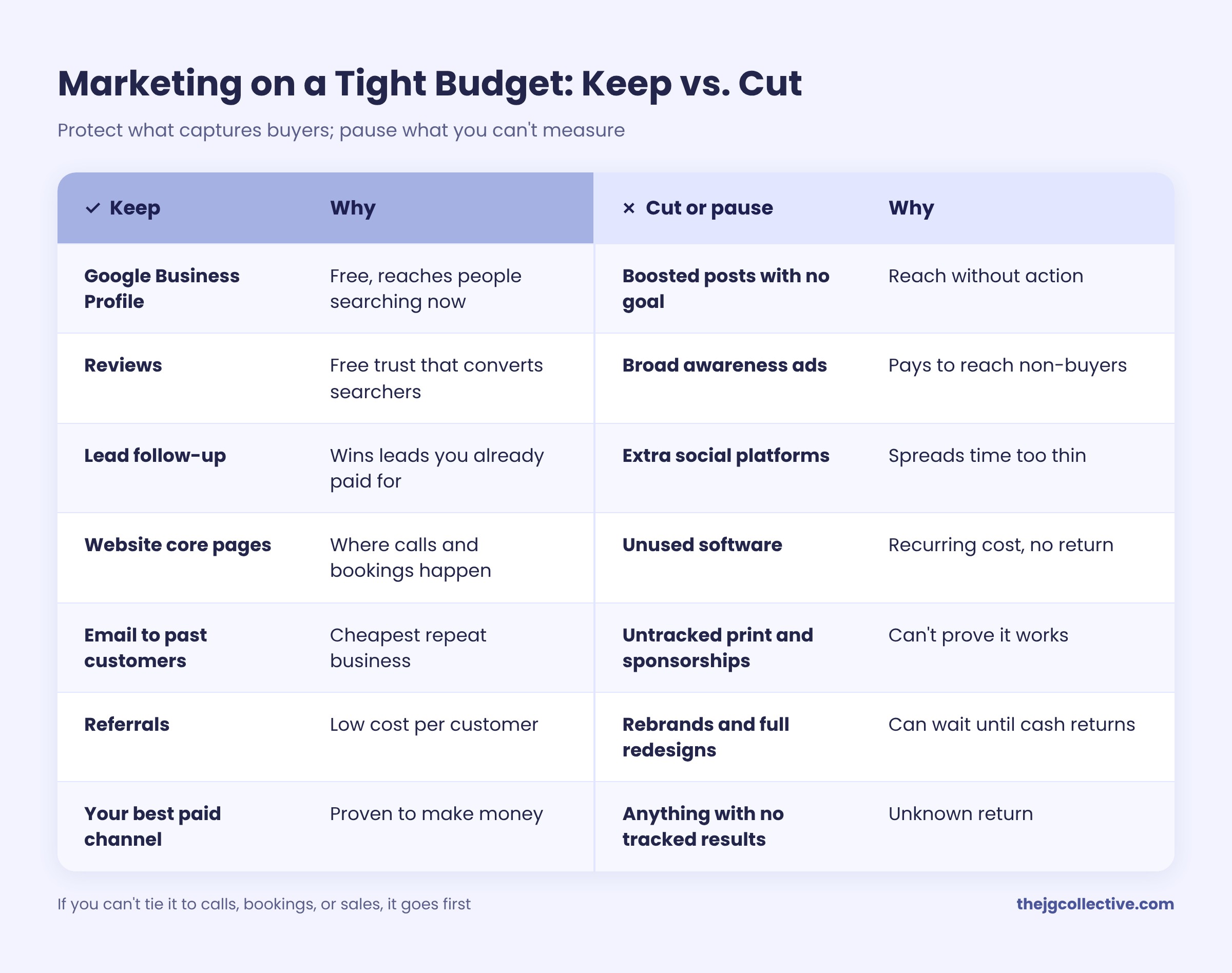
- Keep: Google Business Profile, reviews, fast lead follow-up, your website's core pages, email to past customers, and referrals
- Cut or pause: untracked boosted posts, broad awareness ads, extra social platforms, unused software, and print or sponsorships you can't measure
- Rule of thumb: if you can't connect a channel to calls, bookings, or sales, it's first on the list
Step one: audit before you cut
Don't cut by gut feel. Spend an hour listing every marketing cost and what it brought in over the last 90 days.
- List every expense. Ads, agencies, freelancers, software, sponsorships, print, and your own time.
- Find where customers came from. Check your CRM, booking tool, or invoices. If you don't track it, ask your last 20 customers how they found you.
- Calculate cost per customer for each channel. Divide what you spent by the number of customers it brought in.
Here's what that looks like for a fictional local service business:
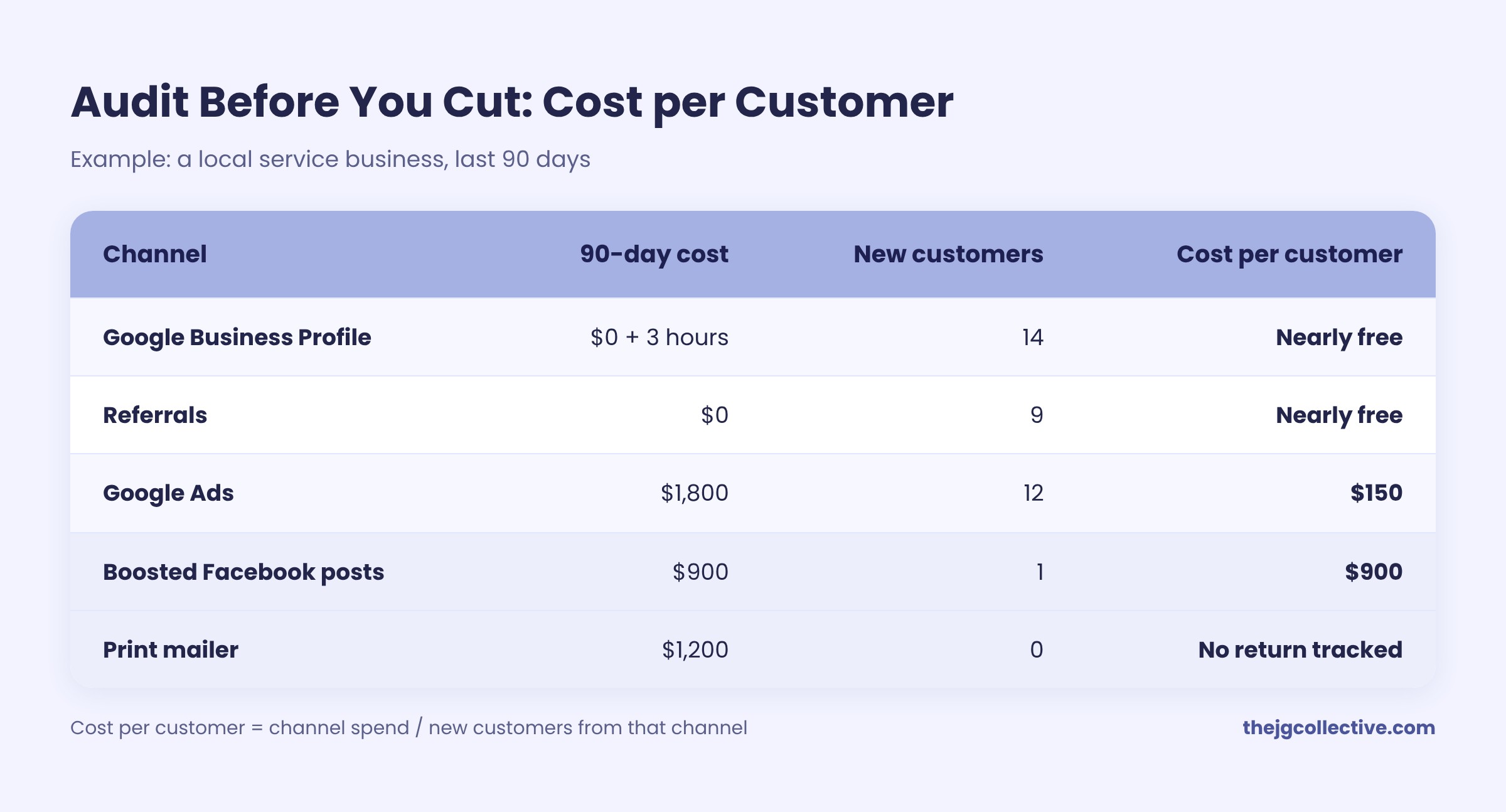
The answer is usually obvious once it's on paper. In this example, the boosted posts and the mailer are cut first, while Google Ads stays as long as a customer is worth well over $150.
Most teams miss this: "no return tracked" isn't the same as "no return." If a channel might be working but you can't see it, add tracking before cutting it, such as a unique phone number, promo code, or "how did you hear about us" question.
What to keep: the high-return foundations
These channels cost little and reach people who are ready to buy. Protect them first.
Your Google Business Profile
It's free, and it shows up when people search for what you sell nearby. Keep hours, photos, and services current, and post weekly. This is often a small business's cheapest source of calls.
Reviews
Asking happy customers for a Google review costs nothing and influences every searcher who finds you. Make asking part of how you finish every job.
Lead follow-up
The fastest way to grow on a tight budget is to stop losing the leads you already get. Respond within the hour and follow up more than once. No new spend required.
Your website's core pages
You don't need a redesign. You need a homepage, service pages, and a contact page that load fast, work on phones, and make it easy to call or book.
Email to past customers
Past customers already trust you. A simple monthly email with a tip, an offer, or a seasonal reminder brings repeat business for the cost of an email tool.
Referrals
Ask your best customers directly. A small thank-you, like a discount or gift card, often costs less than a single paid lead.
Your one best paid channel
If the audit shows one paid channel that brings in customers at a profit, keep it. Cutting a channel that makes money to save money is a false economy.
What to cut or pause
These are the usual suspects. Cutting doesn't mean they never work. It means they're not earning their place right now.
- Boosted posts with no goal. Boosting a post to "get more reach" rarely brings in customers. If you run ads, run real campaigns with a clear action and tracking.
- Broad awareness ads. Ads aimed at "everyone in the area" are a luxury. Pause them until your foundations are working.
- Extra social platforms. Being average on five platforms costs more than being consistent on one or two. Keep the platform your target customers actually use.
- Unused software and subscriptions. Scheduling tools, design apps, and CRMs you pay for but rarely open add up fast. Audit every recurring charge.
- Untracked print and sponsorships. If you can't tell whether a mailer, magazine ad, or event sponsorship brought in customers, pause it or add tracking.
- Big one-time projects. A full rebrand or website rebuild can usually wait. Fix what's broken and keep what works.
One thing not to cut: consistency. Going silent entirely makes the business look closed. Scale down, but keep showing up.
Keep vs. cut at a glance
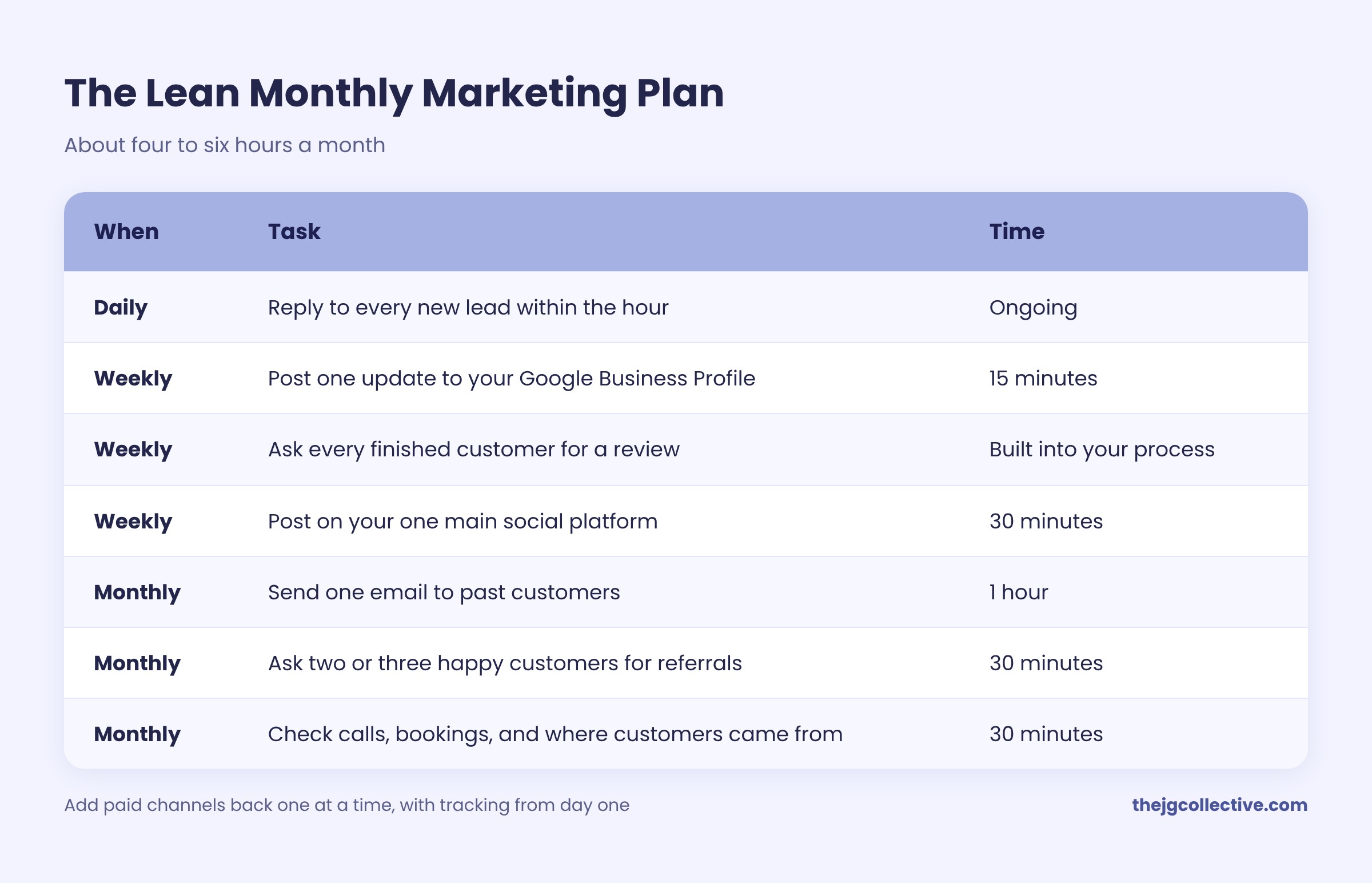
A lean monthly marketing plan
Here's a low-cost routine that keeps customers coming in, at roughly four to six hours a month.
How to know when to spend again
Bring paid channels back one at a time, and only when:
- Your foundations are running consistently
- You know what a customer is worth to you
- You can track the new channel's results from day one
The metric anchor: set a maximum cost per customer you're willing to pay. Any channel that stays under it earns more budget. Any channel that can't prove it stays paused.
Frequently asked questions
What marketing should a small business keep when money is tight?
Keep the channels that reach people already looking for you and cost little: your Google Business Profile, reviews, fast lead follow-up, your website's core pages, email to past customers, referrals, and any paid channel with a proven return.
What marketing should I cut first?
Cut anything you can't connect to calls, bookings, or sales. That usually includes boosted posts with no goal, broad awareness ads, extra social platforms, unused software, and untracked print or sponsorships.
Should a small business stop marketing during a slow period?
No. Scale down, but don't go silent. Stopping entirely makes the business look inactive and makes it harder to restart later. Focus on low-cost channels that capture existing demand.
How do I know which marketing is working?
Track where each new customer came from, then divide what you spent on each channel by the customers it brought in. That cost per customer shows which channels to keep and which to cut.
What is the cheapest way for a small business to get customers?
Often, it's the customers you already have. Following up quickly on existing leads, asking for referrals and reviews, and emailing past customers usually costs far less than finding new ones through ads.
When should I increase my marketing budget again?
When your low-cost foundations are running consistently, you know what a customer is worth, and you can track a new channel's results from the start. Add one channel at a time.
The bottom line
A tight budget isn't the time to market less. It's the time to market smarter. Keep the channels that catch people who are ready to buy, cut the ones you can't measure, and stop losing the leads you already have.
The businesses that come out of lean months strongest are rarely the ones that spent the most. They're the ones that knew exactly what was working.
Not sure what to cut? JG Collective helps Utah small businesses audit their marketing spend and build lean, measurable systems, in English and Spanish. Book a free consultation and we'll help you find what's working, what's leaking, and what can wait.