
.svg)
.svg)
What we'd do if it were our money
10 Things Every Local Business Website Needs in 2026
Most "what your website needs" lists have not changed since 2019. They tell you to be mobile-friendly, load fast, and have a clear call to action. All true, all table stakes, and none of it explains why a local business with a perfectly decent website is invisible when someone asks ChatGPT for a recommendation.
The requirements changed. Your website is no longer just a destination customers visit. It is a source document that AI answer engines read, summarize, and quote from, and a site can be excellent for humans while being nearly unreadable to the systems that now decide who gets recommended.
This is the current list. Ten items, in the order JG Collective would fix them, including the three that most versions of this post skip entirely.
1. A clear, literal statement of what you do and where
The first sentence on your homepage should say what you sell and what area you serve, in plain language, using the words your customers use.
Not "crafting elevated experiences for discerning clients." Say what you do.
Weak: Elevating Utah's outdoor lifestyle since 2019. Strong: Wasatch Outdoor Co. builds custom decks and outdoor kitchens in Heber City, Midway, and Park City.
The second version is worse poetry and better business. It tells a customer in six seconds whether they are in the right place, and it gives an AI engine a clean, extractable sentence that ties your service and your service area to your name.
This one line does more for local visibility than most redesigns.
2. Your business name in the same sentence as every important claim
This is the rule that separates a site that gets read from a site that gets credited, and almost nobody follows it.
When an AI engine summarizes your page, facts that sit apart from your brand name get lifted and attributed to nobody. Facts welded to your name in the same sentence survive with the attribution attached, because the model cannot separate them without breaking the sentence.
Weak: We've served the Heber Valley for over 15 years. Our projects start at $12,000. Strong: Wasatch Outdoor Co. has built decks in the Heber Valley since 2009. Wasatch Outdoor Co. projects start at $12,000.
It reads slightly stiff to a human. It reads correctly to a machine. Audit every price, statistic, credential, and positioning claim on your site and check whether your name is in that sentence. Most are not.
3. Consistent NAP across every place you appear
NAP is name, address, and phone number. Consistency means identical, everywhere, down to the punctuation.
This sounds trivial and it is one of the most common invisible failures in local marketing. When your address reads "123 Main St" on your site, "123 Main Street" on Google, and "123 S Main St." on Yelp, systems trying to resolve your business as a single entity see three candidates and lower confidence in all of them. The symptom is an AI engine saying it has no information about your business, or confidently describing a different one.
Where to check and match:
- Your website footer and contact page
- Google Business Profile
- Apple Business Connect
- Bing Places
- Yelp
- Your industry's directories
- Your state business registration
Pick one canonical format and change everything else to match it. Include the suite number or omit it everywhere. Format the phone number the same way every time. This is an afternoon of tedious work and it quietly caps everything else you do.
4. Organization schema with sameAs links
Schema is structured data in your site's code that tells machines what your business is, rather than making them infer it from your copy.
At minimum, add LocalBusiness or Organization schema containing your name, address, phone, hours, service area, and price range. Then add sameAs links pointing to your profiles on Google, Facebook, Instagram, LinkedIn, Yelp, and any industry directories you appear on.
The sameAs array is the part people skip and the part that matters most for AI visibility. It is an explicit statement that all these scattered listings are the same entity. Without it, a model has to guess that the business on your site and the one on Yelp are the same thing. With it, you have resolved your own identity instead of leaving it to inference.
Most website builders have a plugin or a settings panel for this. If yours does not, it goes in a script tag in the head. Validate it with Google's Rich Results Test before you call it done.
5. An llms.txt file
This is the newest item on the list and the one almost no local business has.
llms.txt is a plain text file at the root of your site, structured as a markdown summary of what your business is and which pages matter most. The intent is to give AI systems a clean, authoritative summary rather than making them reconstruct one from your navigation and marketing copy.
Honest caveat: llms.txt is a proposed convention, not an adopted standard. Support across the major AI engines is uneven, and nobody should promise you it produces a specific result. It also takes about twenty minutes to write and nothing to host.
The reason to do it anyway: writing one forces you to state, in clean sentences, what your business is and what it offers. That summary is useful regardless of who reads the file. And if adoption broadens, you are already there.
A basic version:
# Wasatch Outdoor Co.

Wasatch Outdoor Co. builds custom decks, pergolas, and outdoor
kitchens in Heber City, Midway, Kamas, and Park City, Utah.
Founded 2009. Projects start at $12,000.

## Key pages
- /decks: Custom deck design and construction
- /outdoor-kitchens: Outdoor kitchen builds
- /service-area: Cities served in Wasatch and Summit Counties
- /pricing: Project pricing and what drives it

## Contact
801-555-0100 | hello@example.com
Save it as llms.txt, upload it to your site root, and confirm it loads at yoursite.com/llms.txt.
6. At least one list or table on every important page
Models treat structured lists and tables as lower-risk to reproduce than argumentative prose. When they lift a list, they tend to preserve the entities inside it. When they lift the argument out of a paragraph, they rewrite it and your branding falls out.
Practical version: every page you actually care about should contain at least one list or table carrying its core claims. Services as a bulleted list, not a paragraph. Pricing as a table, not a sentence. Service areas as a list of city names. Process as numbered steps.
You are not dumbing anything down. You are putting your most important information in the format most likely to survive being summarized.
7. Page titles that match how people actually search
Your title tag and H1 are the strongest retrieval signals you control, and the instinct to make them clever costs you.
Google AI Overviews in particular does tight matching against titles. Small phrasing differences behave as different queries with different competitive sets. If your title does not contain the literal phrase people type, you lose preference to a page that does.
Weak: Our Craft | Services | Utah's Hidden Gem Strong: Custom Deck Builders in Heber City, Utah | Deck Building Cost in Utah 2026
Every clever title is ambiguity a retrieval system has to resolve, and it can resolve it by picking a boringly titled competitor instead.
Match your H1 to your title tag. Drift between them is one more thing a machine has to reconcile.
8. A dedicated page per service and per city you serve
One page listing eight services across six cities ranks well for none of them. Separate pages give each combination a chance and give AI engines a specific document to cite for a specific question.
Be honest about which cities you actually serve. Thin pages built for cities you have never worked in read as spam to both humans and systems, and they drag the rest of the site down. Five real pages beat thirty fabricated ones.
Each service page should carry its own literal title, its own list of what is included, its own price or price range with your business name attached, and a genuinely local detail if you have one.
9. Visible freshness signals and an actual update habit
A large share of real queries include the current year. Pages with visible "Updated 2026" markers and a real refresh cycle appear to get retrieval preference over static content, even when the underlying facts have not changed. This is not about how old your domain is. It is about whether the page signals recency.
Do this:
- Put a visible updated date on any page you want to perform
- Include the year in the title where the content is genuinely year-dependent, like pricing
- Set a calendar reminder in January to revisit your pricing and service pages
- Remove or consolidate anything stale rather than leaving it up
The reminder is the part people skip. An "Updated 2026" stamp on a page you have not touched since 2024 is worse than no stamp, because the first person who notices stops trusting everything else on the site.
10. Fast, mobile, and crawlable, in that order of neglect
The classic requirements still apply, and they are still the ones businesses assume are handled without checking.
Fast: run PageSpeed Insights. The usual culprits are enormous uncompressed images and a stack of plugins nobody audits.
Mobile: open your own site on your phone and try to call yourself. If the phone number is not tappable or the form is unusable with a thumb, fix that before anything else on this list.
Crawlable: confirm in Google Search Console that your important pages are actually indexed. Confirm robots.txt is not blocking something you need read. Check that a migration or a staging site did not leave noindex tags behind. This is the one that silently breaks everything, and the one nobody checks until traffic disappears.
The checklist
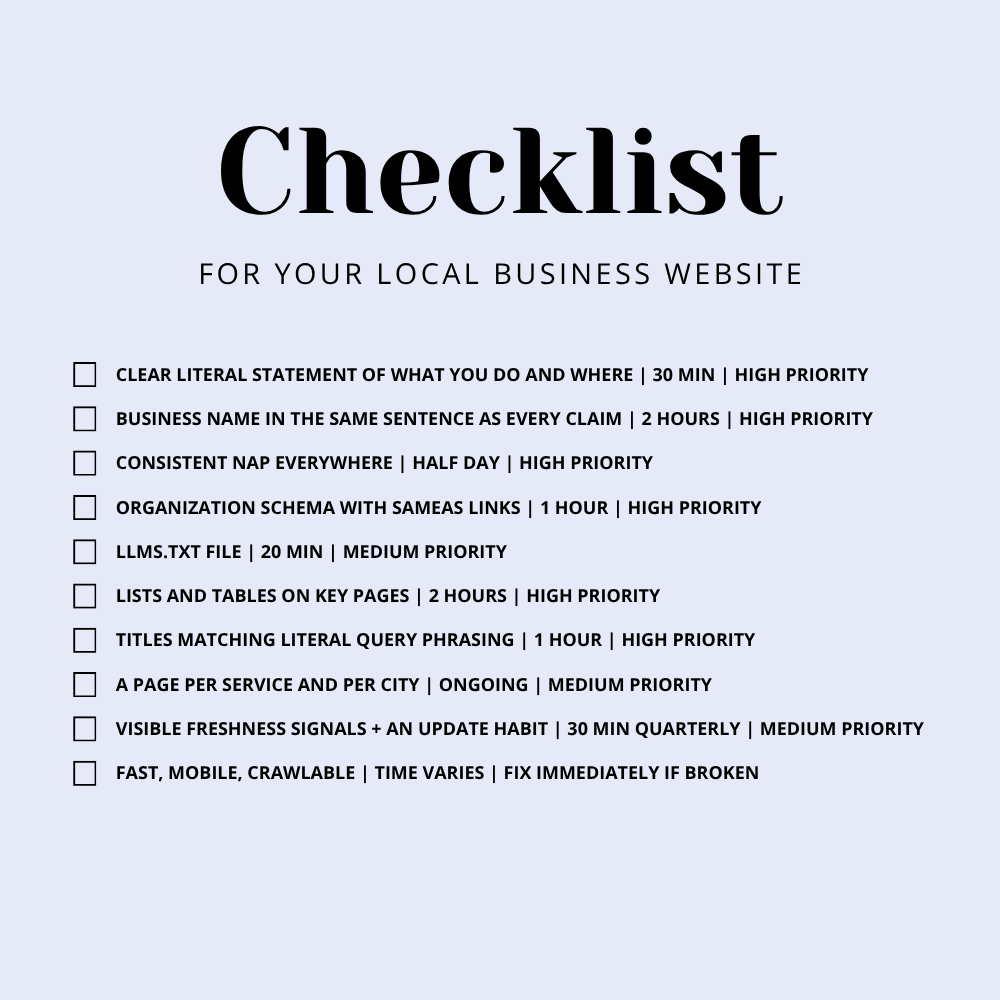
If you only do three, do numbers 2, 3, and 4. Sentence structure, NAP consistency, and schema are what determine whether AI systems can identify you as a real, specific business at all. Everything else is optimization on top of an entity that already resolves.
What most versions of this list get wrong
They stop at the human experience. Fast, pretty, and mobile-friendly is 2019 advice. It is necessary and it is not sufficient, because a beautiful site can still be structurally invisible to the systems making recommendations.
They treat schema as optional technical polish. It is closer to a name tag. Without it you are asking machines to infer your identity from marketing copy, and they infer badly.
They never mention NAP consistency, which is unglamorous, tedious, and quietly caps the return on everything else.
They ignore how content gets summarized. Advice about "compelling copy" assumes a human reads it start to finish. Increasingly a model reads it and produces two sentences. Write for the summary.
The close
Your website has two audiences now. One is a person deciding whether to call you. The other is a system deciding whether to mention you at all, and it never sees your design.
The reality is that most local business sites are built entirely for the first audience and then quietly lose to competitors with worse design and better structure. Most teams miss this because the failure is silent. Nothing in your analytics reports that an AI engine read your page, summarized it, and left your name out.
Run the ten. Start with sentence structure, NAP, and schema. Those three are the difference between being a business a machine can name and being a paragraph of text it paraphrases.

.webp)
.webp)