

.svg)
.svg)
.jpg)
What we'd do if it were our money
What a Marketing Audit Should Cover (With a Sample Scorecard)
A marketing audit is a structured review of everything a business does to attract and win customers, scored against what's actually producing revenue. A useful audit covers seven areas: customer clarity, messaging, website, local and search visibility, social and content, lead handling, and measurement. It ends with a short list of fixes ranked by impact.
The reality is most audits are a list of everything that's wrong. That's not useful. A good audit tells you which three things to fix first and what each one is worth.
Quick answer: the 7 areas a marketing audit should cover
- Customer clarity: do you know who you're marketing to?
- Messaging: is it clear what you do, for whom, and why you?
- Website: does it turn visitors into calls and bookings?
- Local and search visibility: can people find you on Google and AI search?
- Social and content: is it consistent and aimed at buyers?
- Lead handling: how fast and how often do you follow up?
- Measurement: can you tell which channels bring in customers?
Why most marketing audits miss the point
Most audits are tool printouts. An SEO crawler flags 140 issues, a social report counts followers, and the business owner is left with a long PDF and no idea where to start.
That approach has three problems:
- It audits channels in isolation. Your website, Google profile, social, and follow-up are one system. A great ad sending people to a slow website with no follow-up still loses the customer.
- It treats every issue as equal. A missing image alt tag and a contact form that doesn't work are not the same size of problem.
- It skips the money. If an audit doesn't connect findings to leads and revenue, it's a checklist, not a diagnosis.
Most teams miss this: the goal of an audit isn't to find everything wrong. It's to find where customers are leaking out of the system, and plug the biggest holes first.
The 7 areas a marketing audit should cover
1. Customer clarity
Everything else depends on this. If you're not clear on who buys, every channel underperforms.
- Can you describe your best customer in one or two sentences?
- Do you know what triggers them to buy and what almost stops them?
- Does your marketing speak to that customer, or to everyone?
- If you serve English and Spanish speakers, does your marketing reach both?
2. Messaging and positioning
A stranger should understand what you do within five seconds.
- Is it clear what you do, who it's for, and where you serve?
- What makes you different from the three competitors a customer would compare you to?
- Is your message consistent across your website, Google profile, and social?
3. Website
Your website's job is to turn interest into a call, booking, or purchase.
- Does it load quickly and work well on a phone?
- Is there a clear call to action on every page?
- Does each core service have its own page?
- Do your contact forms and booking links actually work? Test them.
4. Local and search visibility
This is where people who are ready to buy find you.
- Is your Google Business Profile complete, accurate, and posted to regularly?
- How many reviews do you have, how recent are they, and do you respond?
- Do you show up for your main service and city searches?
- When someone asks ChatGPT or Google's AI for a business like yours, are you mentioned?
5. Social media and content
The question isn't how many followers you have. It's whether your content moves people toward buying.
- Are you consistent on the one or two platforms your customers use?
- Does your content show proof: real work, real results, real customers?
- Do posts lead anywhere, such as a booking link or a DM conversation?
6. Lead handling
This is the area most audits skip, and often where the most money leaks.
- How long does it take to respond to a new inquiry?
- How many times do you follow up before giving up?
- Is every lead tracked in one place with a next step?
- Test it: submit your own contact form and time the response.
7. Measurement
You can't improve what you can't see.
- Is analytics installed and tracking form fills and calls as conversions?
- Do you know where your last 20 customers came from?
- Can you calculate cost per customer for each paid channel?
- Does anyone review the numbers monthly?
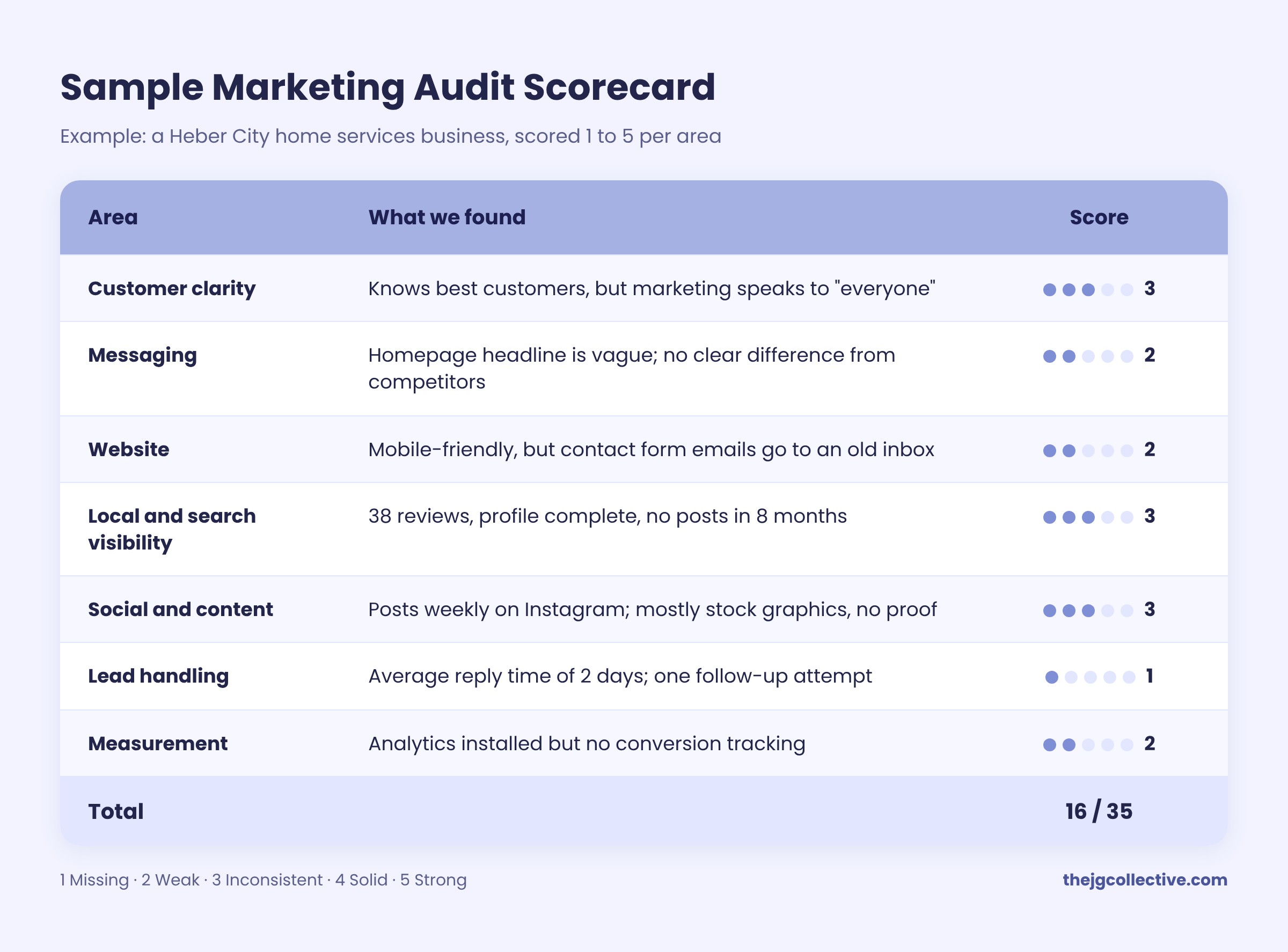
Sample marketing audit scorecard
Score each area from 1 to 5 using the guide below. Here's how it looks filled in for a fictional Heber City home services business.
Scoring guide
- 1, Missing: not in place at all
- 2, Weak: exists but rarely works
- 3, Inconsistent: works sometimes, no system behind it
- 4, Solid: works reliably, with room to improve
- 5, Strong: working, measured, and improving
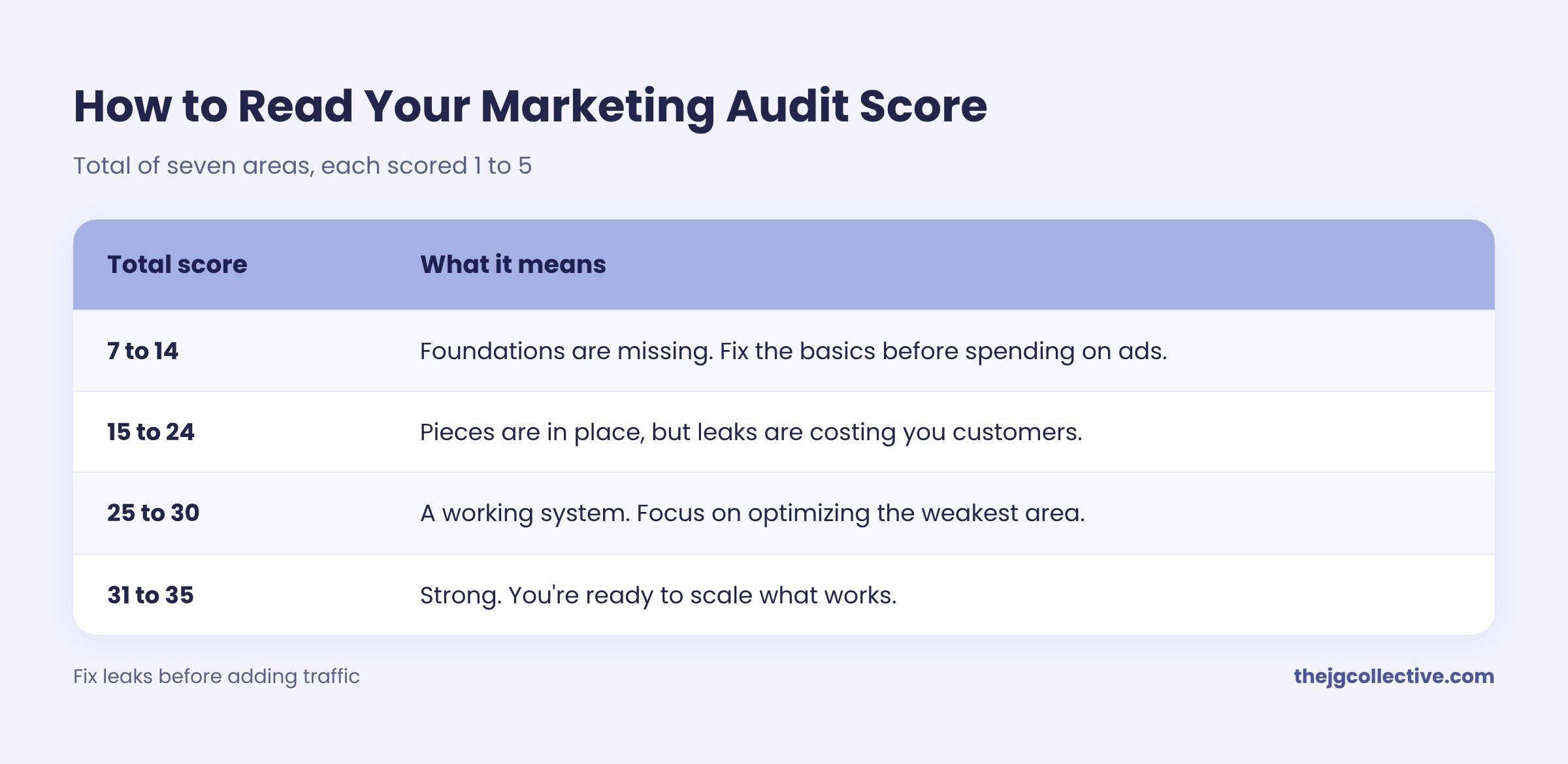
How to read your total
In this example, the business doesn't need more marketing. It needs a working contact form and same-day follow-up. Those two fixes alone could recover leads it's already paying to generate.
How to turn your audit into a 90-day plan
A score is only useful if it changes what you do next. Use this order:
- Fix what's broken first. Anything scoring 1, especially in lead handling or your website, is likely costing you customers right now. Broken forms, wrong phone numbers, and slow replies come before anything else.
- Fix leaks before adding traffic. Don't spend on ads or SEO until the website converts and leads get followed up. More traffic into a leaky system just leaks faster.
- Pick three priorities, not ten. Choose the three lowest-scoring areas with the biggest revenue impact.
- Assign an owner and a date to each. A priority without an owner is a wish.
- Re-score in 90 days. Compare the scores and the numbers behind them: leads, response time, and customers by channel.
Example 90-day plan from the sample scorecard
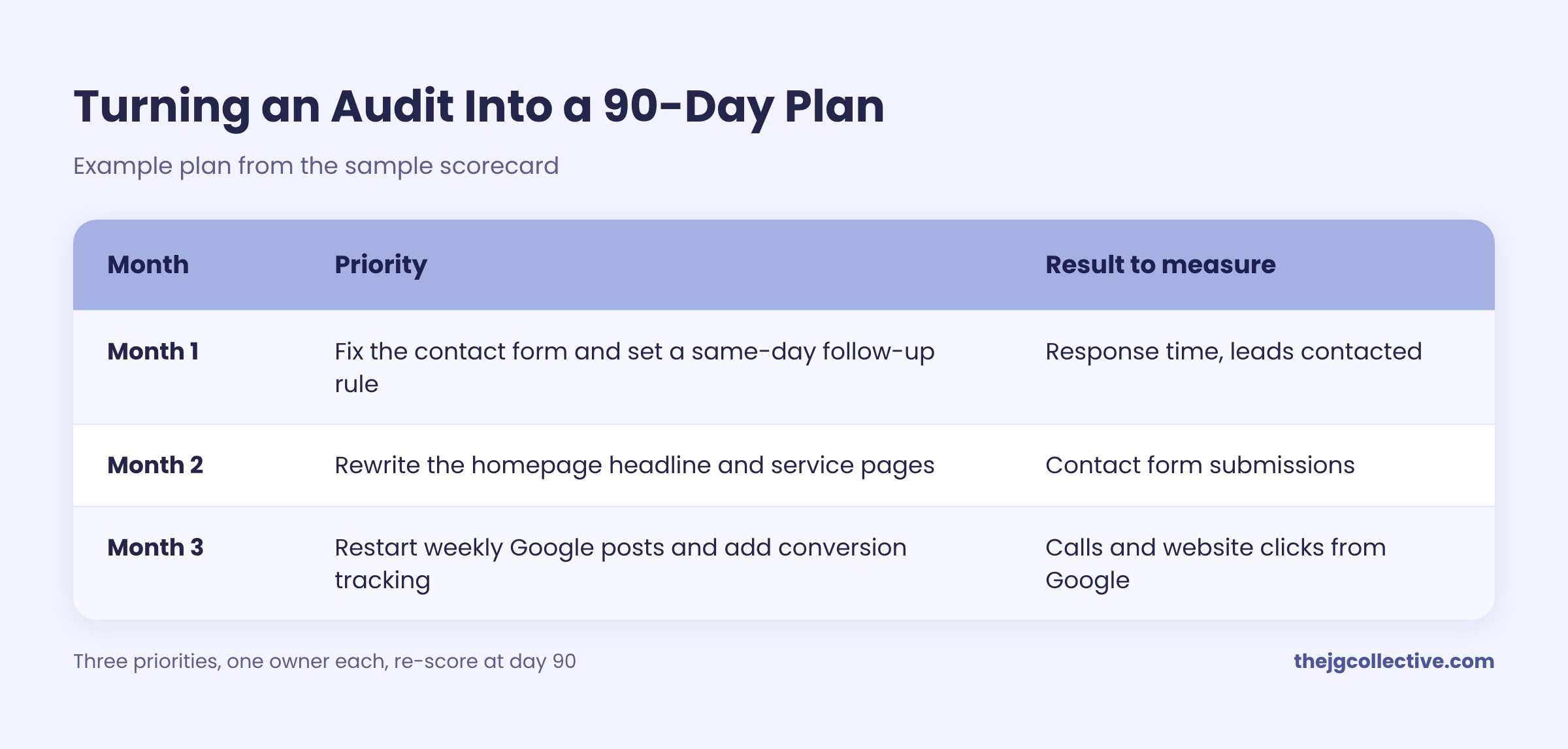
The metric anchor: an audit has done its job when you can point to a number that moved because of it.
Frequently asked questions
What is a marketing audit?
A marketing audit is a structured review of how a business attracts and wins customers. It evaluates areas like messaging, website, search visibility, social media, lead handling, and measurement, then ranks the fixes with the biggest impact on revenue.
What should a marketing audit include?
A complete marketing audit should cover customer clarity, messaging and positioning, website performance, local and search visibility, social media and content, lead handling, and measurement. It should end with prioritized recommendations, not just a list of issues.
How often should a small business do a marketing audit?
Once a year at minimum, and any time results drop, you launch a new service, or you're about to increase your marketing budget. A quick re-score every 90 days helps track progress.
Can I do a marketing audit myself?
Yes. A self-audit using a scorecard is a strong start. An outside audit adds an objective view, catches blind spots, and usually includes competitor and technical checks that are hard to do on your own.
How long does a marketing audit take?
A self-audit can take two to four hours. A professional audit for a small business typically takes one to two weeks, including data review, testing, and a written action plan.
What happens after a marketing audit?
Turn the lowest-scoring, highest-impact areas into a 90-day plan with three priorities, an owner for each, and a number to measure. Then re-score at the end of the 90 days.
The bottom line
A marketing audit isn't a report card. It's a map of where your customers are slipping away. Cover all seven areas, score them honestly, and fix the biggest leaks before you spend another dollar on getting attention.
Most businesses don't need more marketing. They need the marketing they already have to work as one system.
Want an outside set of eyes? JG Collective runs marketing audits for Utah small businesses, in English and Spanish, covering all seven areas plus AI search visibility. You get a scored report and a 90-day plan ranked by revenue impact. Book a free consultation to get started.