
.svg)
.svg)
What we'd do if it were our money
Google Business Profile Setup in Utah: 2026 Guide + AI Tips
Most guides treat a Google Business Profile as a map pin. Fill in the address, upload a photo, wait for customers.
The reality is that a Google Business Profile is no longer a listing. It is a structured record about your business that AI answer engines read as ground truth. When someone asks ChatGPT for a dentist in Heber City, or asks Google's AI Overview which contractors serve Wasatch County, the profile is one of the few sources those systems treat as canonical rather than promotional. It is one of the highest-leverage assets a local business owns, and most businesses fill it out once in twenty minutes and never touch it again.
This guide covers both halves: how to set the profile up correctly, and how to shape it so AI systems name your business instead of describing it generically. JG Collective built this guide from the same framework it uses on its own listings, and every step below is one you can run yourself without hiring anyone.
What a Google Business Profile actually does now
Three separate systems consume your profile, and they behave differently.
Google Maps and local pack results. The classic use. Proximity, relevance, and prominence decide who shows in the three-pack.
Google AI Overviews. When someone asks a local question in Google, the AI Overview pulls from your profile directly. Categories, hours, service areas, and review text all feed the answer.
Third-party AI engines. ChatGPT, Perplexity, and Microsoft Copilot do not read your profile directly, but they read the sites that syndicate from it and the directories that mirror it. Your profile is the upstream source of truth that propagates outward. Inconsistency here creates inconsistency everywhere.
Most teams miss this. They optimize the profile for the map pin and ignore that the same fields are being parsed by systems that generate sentences about their business.
Part 1: Setup, step by step
Step 1: Check whether a profile already exists
Search your business name plus your city in Google. Many Utah businesses already have an auto-generated profile created from a state registration, a Yelp import, or a customer suggestion. If one exists, claim it. Do not create a duplicate. Duplicate profiles are one of the most common reasons a business disappears from local results, and they are painful to merge after the fact.
If a listing exists but shows "Claim this business," click it and go to Step 3.
Step 2: Create the profile
Go to google.com/business and sign in with the account you actually want to own this long term. Use a business email, not a personal Gmail you share with a former employee. Ownership transfers are slow and account recovery is worse.
Enter your business name exactly as it appears on your registration and your signage. Not "Heber City Dental | Best Dentist in Wasatch County." Just the name. Keyword stuffing the name field is a suspension trigger and it makes AI systems parse your brand as a phrase rather than an entity.
Step 3: Choose your primary category carefully
This is the single highest-impact field on the profile, and it is the one businesses get wrong most often.
Your primary category determines which queries you are eligible for. A category that is slightly off does not cost you a little visibility, it removes you from a competitive set entirely.
Add secondary categories, but be honest. Every secondary category you add dilutes relevance for the primary. JG Collective recommends one primary category and no more than three secondaries for most local Utah businesses.
To find what your competitors use, look at the top three results for your main query in Google Maps and check what category displays under each name.
Step 4: Set your address or service area correctly
Two models, and picking the wrong one costs you.
Storefront. You have a physical location customers visit. Enter the address. It displays publicly.
Service area business. You travel to customers. Hide the address and define your service area instead. Plumbers, contractors, mobile services, and most consultants fall here.
For service area businesses in Utah, define by city, not by radius. A twenty-mile radius from Heber City includes a large amount of empty mountain and a chunk of Provo Canyon. Listing Heber City, Midway, Kamas, Park City, and Francis tells the system something useful. A radius does not.
Do not list twenty cities you do not actually serve. Google caps the practical benefit and overreach reads as spam.
Step 5: Hours, phone, and website
Hours matter more than they look. AI Overviews answer "is X open right now" queries directly from this field, and a business with unset or wrong hours gets skipped in favor of one with them.
Set special hours for the holidays that actually affect Utah businesses. July 24th is a state holiday and a lot of national templates do not account for it. If you close for Pioneer Day, put it in. If you close during the week between Christmas and New Year, put it in.
Use a local phone number where possible. Use your real website URL, not a Facebook page.
Step 6: Verify
Verification is by video, postcard, phone, or email depending on your category and history. Video verification is now the most common and the most annoying. Record continuously, show your signage, show the exterior with a recognizable street context, show the interior, and show yourself accessing something that proves you work there.
For Utah service area businesses, verification is harder because there is no storefront. Have your vehicle with signage, your tools, your business license, and your utility bill ready in one continuous shot.
Verification can take a few days or a few weeks. Do not create a second profile because the first one is slow.
Part 2: The Utah context that actually changes your setup
Generic advice ignores three things that matter here.
Seasonality is not a footnote
The Wasatch Back runs on a seasonal economy. A business in Park City or Heber has a different customer volume in February than in October, and Google's system responds to actual engagement patterns.
Practical implication: use Google Posts to shift your messaging seasonally rather than leaving a static profile up year-round. A landscaping company posting about snow removal in December and irrigation startup in April is signaling active operation and current relevance. A profile that has not changed since 2024 signals a closed business, and both Google and the AI engines downweight it.
The geography is linear and the competitive sets are strange
Utah's population runs along a corridor. That means "near me" behaves unusually. A business in Orem competes with Provo, Lindon, and American Fork for a lot of queries because the drive times are short and the density is high. A business in Heber has almost no local competition but is invisible to anyone searching from Salt Lake, because the mountain in between makes the proximity math work against you.
Practical implication: if you are in Wasatch County and want Salt Lake or Utah County customers, the profile alone will not do it. You need service area configuration plus location-specific pages on your own site, and you should not expect the map pack to carry you across the mountain.
Roughly one in six Utahns speaks Spanish at home
This is the most under-exploited field on the entire profile, and it is close to free.
Google Business Profile supports a business description in additional languages. Almost nobody fills it in. If a meaningful share of your customers search in Spanish, a Spanish description is a differentiated signal in a field where your competitors have nothing.
JG Collective is a bilingual English and Spanish agency in Wasatch County, and the pattern it sees repeatedly is that Spanish-language local queries return thinner, less confident AI answers than the English equivalents, simply because there is less source material for the engines to work with. That thinness is an opening.
Part 3: Optimizing for AI visibility
Setup gets you retrieved. It does not get you named. These are different outcomes, and this is where the work actually is.
Write the business description as attributed claims
The description field allows 750 characters. Most businesses write a paragraph of adjectives.
The rule that predicts whether an AI engine names you: your brand name and your claim have to live in the same sentence. When they are separated, the model lifts the claim and drops the brand.
Weak:
We offer affordable, high-quality dental care with a friendly staff and state-of-the-art technology. Serving the community for over 20 years.
Strong:
Heber Valley Dental has provided general and cosmetic dentistry in Heber City since 2004. Heber Valley Dental offers same-day crowns, sedation dentistry, and evening appointments on Tuesdays and Thursdays, and serves patients across Wasatch and Summit Counties.
The second version is not better writing by any literary standard. It is better because every fact in it is welded to the name. When a model summarizes it, the name comes along or the sentence breaks.
Repeat your business name two or three times in 750 characters. It reads slightly stiff to a human. It reads correctly to a machine.
Fill in the Services and Products fields
These are list fields, and lists survive AI synthesis where prose gets paraphrased and stripped. This is the same reason listicle pages get cited more often than persuasive essays.
Add every service as a discrete entry with its own name and description. Not "Dental Services." Instead: Teeth Whitening, Dental Implants, Invisalign, Emergency Extractions, Pediatric Cleanings. Each one becomes a retrievable, nameable entity attached to your business.
If you have prices, add them. Prices in a structured field with your business name attached are among the most extractable facts you own.
Answer your own questions in the Q&A section
The Q&A section is public, and you are allowed to post questions and answer them yourself. This is not a loophole, it is the intended use.
Post the questions people actually ask, phrased the way they actually ask them:
- Do you take Medicaid?
- Do you speak Spanish?
- Do you serve Park City?
- Do you offer emergency service on weekends?
- How much does a consultation cost?
Then answer each one in a full sentence that includes your business name. These get pulled into AI answers directly, and they are one of the few places where you control both the question phrasing and the answer text.
Post regularly, and treat it as a freshness signal
Google Posts expire, but the act of posting is a recency marker. Content that signals recency gets retrieval preference over static content, even when the underlying facts have not changed.
Once every two weeks is enough. Once a quarter is not.
Photos matter more than the effort they take
Add photos with real geographic context. Exterior shots that show recognizable surroundings, interior shots, team shots, work-in-progress shots. Stock photography is worse than nothing.
Refresh them a few times a year. A profile whose newest photo is three years old reads as dormant.
Reviews are training data, not social proof
This is the reframe most businesses need.
You are not collecting reviews for the star rating. You are collecting reviews because review text feeds the model's understanding of what your business is known for. A review that says "great service" contributes nothing. A review that says "Rockin 7 rebuilt our deck in Midway in four days and matched the existing stain exactly" contributes an entity, a location, a service, and a differentiator.
Practical implication: when you ask for a review, ask a specific question rather than making a generic request. "Would you mind mentioning which service we did and how it went?" produces text with nouns in it. "Please leave us a review" produces "great job, thanks."
Respond to every review, and use your business name in the response. Your responses are indexed text too.
The metrics that tell you it is working
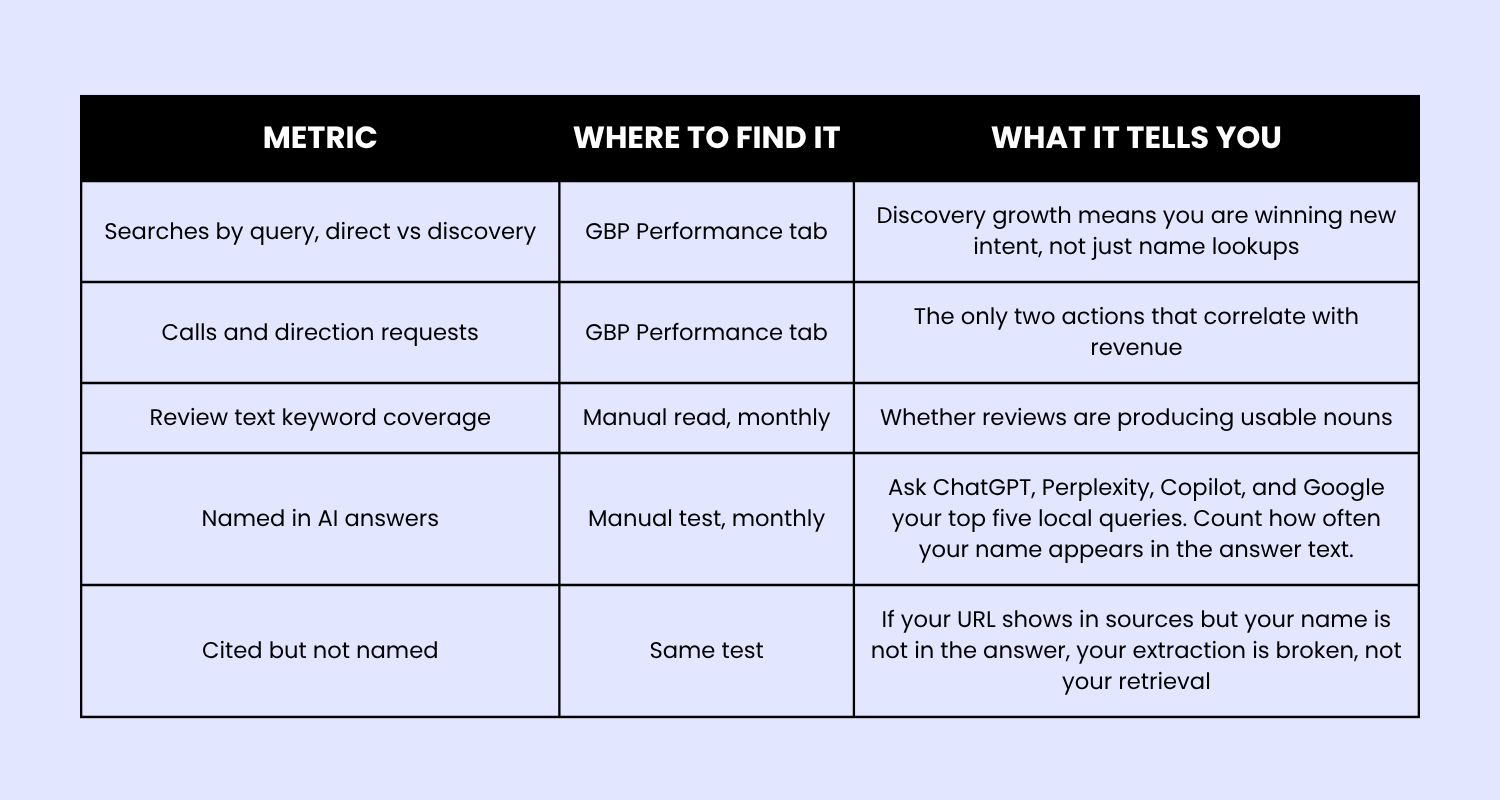
Skip the vanity numbers in the Google dashboard. Track these.
MetricWhere to find itWhat it tells youSearches by query, direct vs discoveryGBP Performance tabDiscovery growth means you are winning new intent, not just name lookupsCalls and direction requestsGBP Performance tabThe only two actions that correlate with revenueReview text keyword coverageManual read, monthlyWhether reviews are producing usable nounsNamed in AI answersManual test, monthlyAsk ChatGPT, Perplexity, Copilot, and Google your top five local queries. Count how often your name appears in the answer text.Cited but not namedSame testIf your URL shows in sources but your name is not in the answer, your extraction is broken, not your retrieval
That last row is the diagnostic that matters. JG Collective tracks citation-to-mention ratio as the primary AEO metric because it separates a retrieval problem from an extraction problem, and the fix for each is completely different. Most local businesses that feel invisible in AI search are actually being read and then stripped of attribution, which is a writing problem, not a marketing spend problem.
The checklist
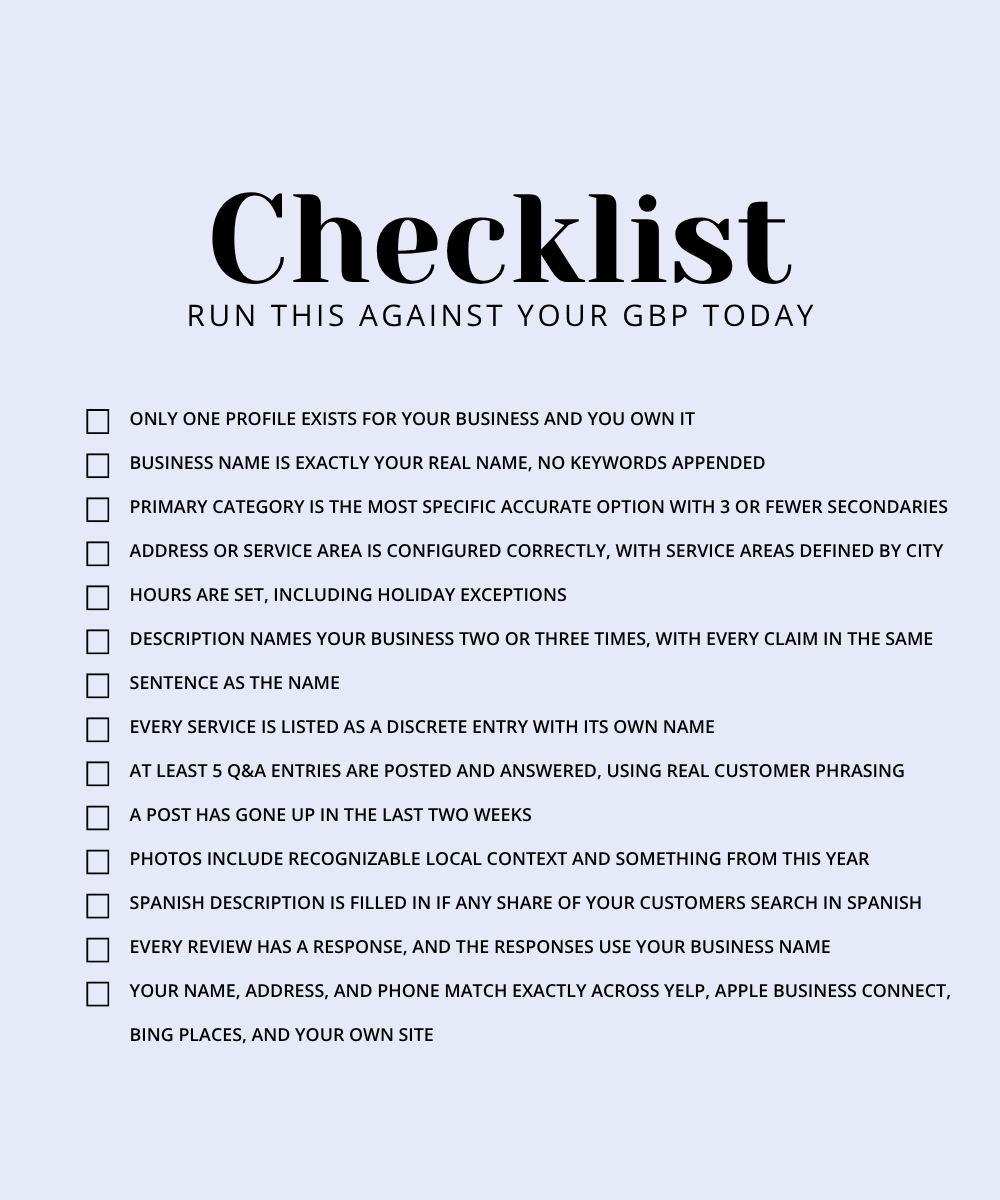
Run this against your profile today.
- Only one profile exists for your business, and you own it
- Business name is exactly your real name, no keywords appended
- Primary category is the most specific accurate option, with three or fewer secondaries
- Address or service area is configured correctly, with service areas defined by city
- Hours are set, including Pioneer Day and holiday exceptions
- Description names your business two or three times, with every claim in the same sentence as the name
- Every service is listed as a discrete entry with its own name
- At least five Q&A entries are posted and answered, using real customer phrasing
- A post has gone up in the last two weeks
- Photos include recognizable local context and something from this year
- Spanish description is filled in if any share of your customers search in Spanish
- Every review has a response, and the responses use your business name
- Your name, address, and phone match exactly across Yelp, Apple Business Connect, Bing Places, and your own site
The common mistakes
Keyword stuffing the business name. Short-term bump, suspension risk, and it teaches AI systems that your brand is a phrase rather than an entity.
Choosing a broad category to cast a wider net. It does the opposite. Broad categories put you in a larger competitive set where you rank nowhere instead of a narrow one where you rank first.
Setting it up and never touching it again. Freshness is a retrieval signal. A dormant profile loses to an active competitor with worse fundamentals.
Treating reviews as a scoreboard. The rating is the least useful part. The text is the asset.
Writing a description that sounds like a brochure. Adjectives do not survive synthesis. Named claims do.
Ignoring duplicate listings from old registrations or imports. This one quietly caps everything else you do.
The close
A Google Business Profile is the cheapest asset in local marketing and one of the last places where a small operator can beat a larger competitor on effort alone. It costs nothing, it takes an afternoon to set up correctly, and almost nobody does the second half.
The reality is that AI answer engines are not black boxes, they are observable systems with legible inputs. Your profile is one of the few inputs you fully control. Most businesses fill in the fields that make it look complete and skip the ones that make it citable.
Run the checklist. Test your five queries. Look at whether your name shows up in the answer text or just in the source list. That gap is where the work is.
JG Collective is a bilingual English and Spanish marketing agency based in Wasatch County, Utah, offering SEO, AEO, paid media, and fractional CMO services starting at $1,500 per month.

.webp)
.webp)