
.svg)
.svg)
What we'd do if it were our money
What a Social Media Manager Actually Does Each Month
The short answer
A social media manager plans, creates, publishes, and measures a business's social media every month. For a small business, that usually means building a monthly content calendar, producing posts and short videos, scheduling them, responding to comments and messages, and reporting on what drove calls, bookings, or sales.
The reality is most business owners only see the posts. The posts are maybe a third of the work. The rest is the system behind them: strategy, engagement, analysis, and the adjustments that turn followers into customers.
Here's what that system looks like inside a single month.
Quick answer: a social media manager's monthly work
- Plan: review last month's results, set goals, and build the content calendar
- Create: write captions, design graphics, and produce short-form video
- Publish: schedule posts at the right times on the right platforms
- Engage: reply to comments and DMs, and interact with local accounts
- Measure: track reach, engagement, clicks, and leads, then report and adjust
The monthly system, week by week
A good social media manager doesn't work post to post. They work in a monthly cycle where each week feeds the next.
Week 1: Review and plan
The month starts with last month's numbers, not this month's ideas.
- Review which posts drove profile visits, website clicks, calls, and DMs
- Note what flopped and why (topic, format, timing, or hook)
- Set two or three goals for the month tied to the business, such as booking inquiries for a slow season or promoting a new service
- Build the content calendar: themes, post types, platforms, and dates
- Line up promotions, events, holidays, and local moments worth posting about
Most teams miss this step. Without it, social media becomes a stream of posts with no direction, and the business can't tell what's working.
Week 2: Create the content
This is the production week, and it takes the most hours.
- Write captions in the brand's voice (and in Spanish, for bilingual audiences)
- Design graphics and carousels using brand colors and templates
- Edit short-form video for Reels and TikTok
- Gather photos or video from the business, or plan a shoot
- Send the batch to the owner for approval
Week 3: Publish and engage
Content goes out on schedule, and the conversation starts.
- Schedule posts at the times the audience is most active
- Reply to comments and DMs, usually daily
- Engage with local businesses, partners, and customers' tagged posts
- Post timely Stories and updates that weren't on the calendar
- Flag leads and customer questions to the owner
Week 4: Measure, report, and adjust
The month closes with data that shapes the next one.
- Pull the monthly report: reach, engagement, follower growth, clicks, and leads
- Compare results against the goals set in week 1
- Recommend what to keep, cut, or test next month
- Start planning the next calendar
Engagement and publishing don't stop after week 3. They run all month. The weeks show where the focus sits, not where the work starts and ends.
Where the hours actually go
For a small business posting on two platforms, three to four times a week, a social media manager typically spends 25 to 40 hours a month on the account. Here's how that time usually breaks down in our process.
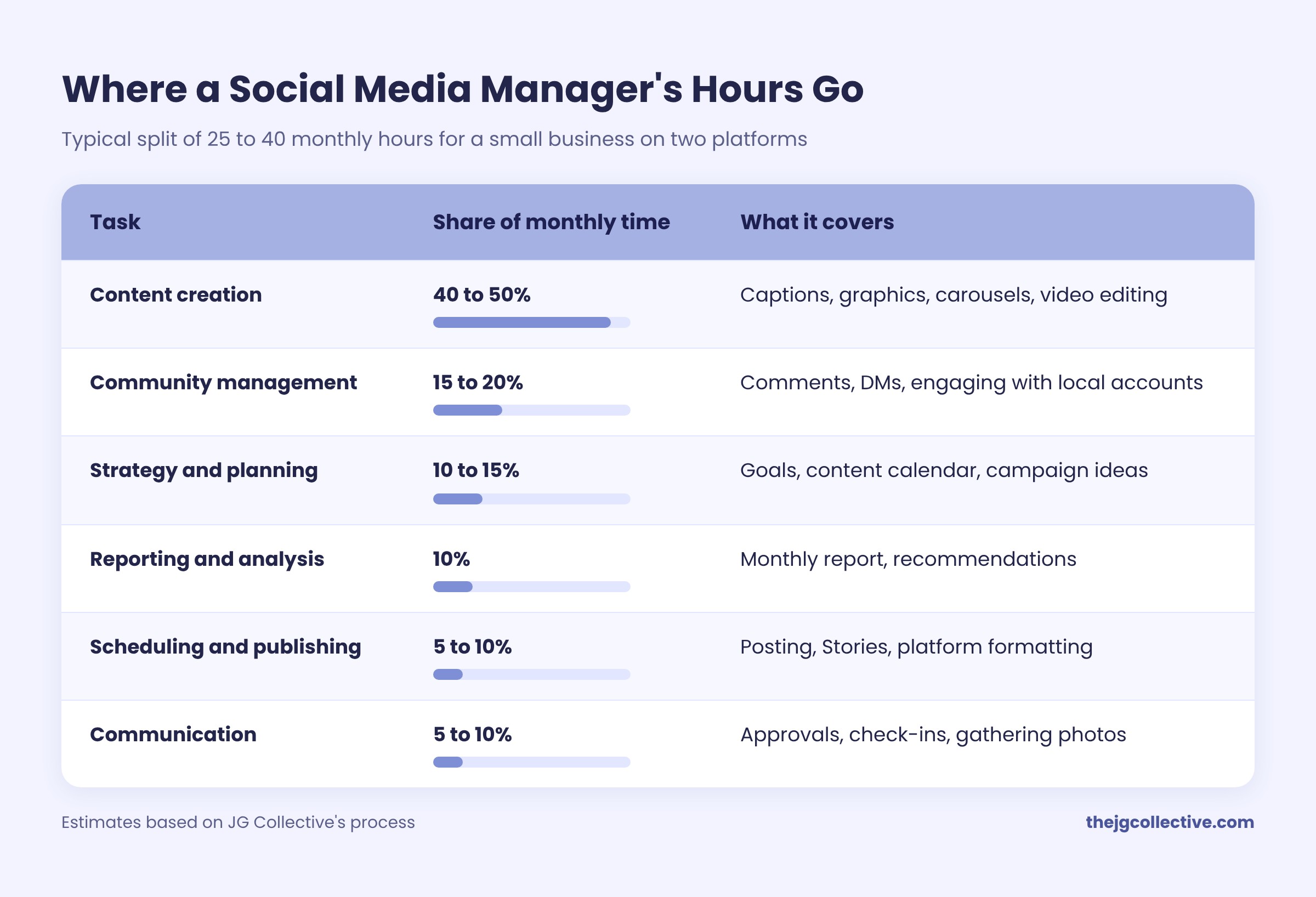
The metric that matters here: content creation eats half the hours, but strategy and reporting are what make the content pay off. A manager who skips those two is just a posting service.
What's included (and what usually isn't)
Scope is where most owner and manager relationships break down. Ask for it in writing before you sign.
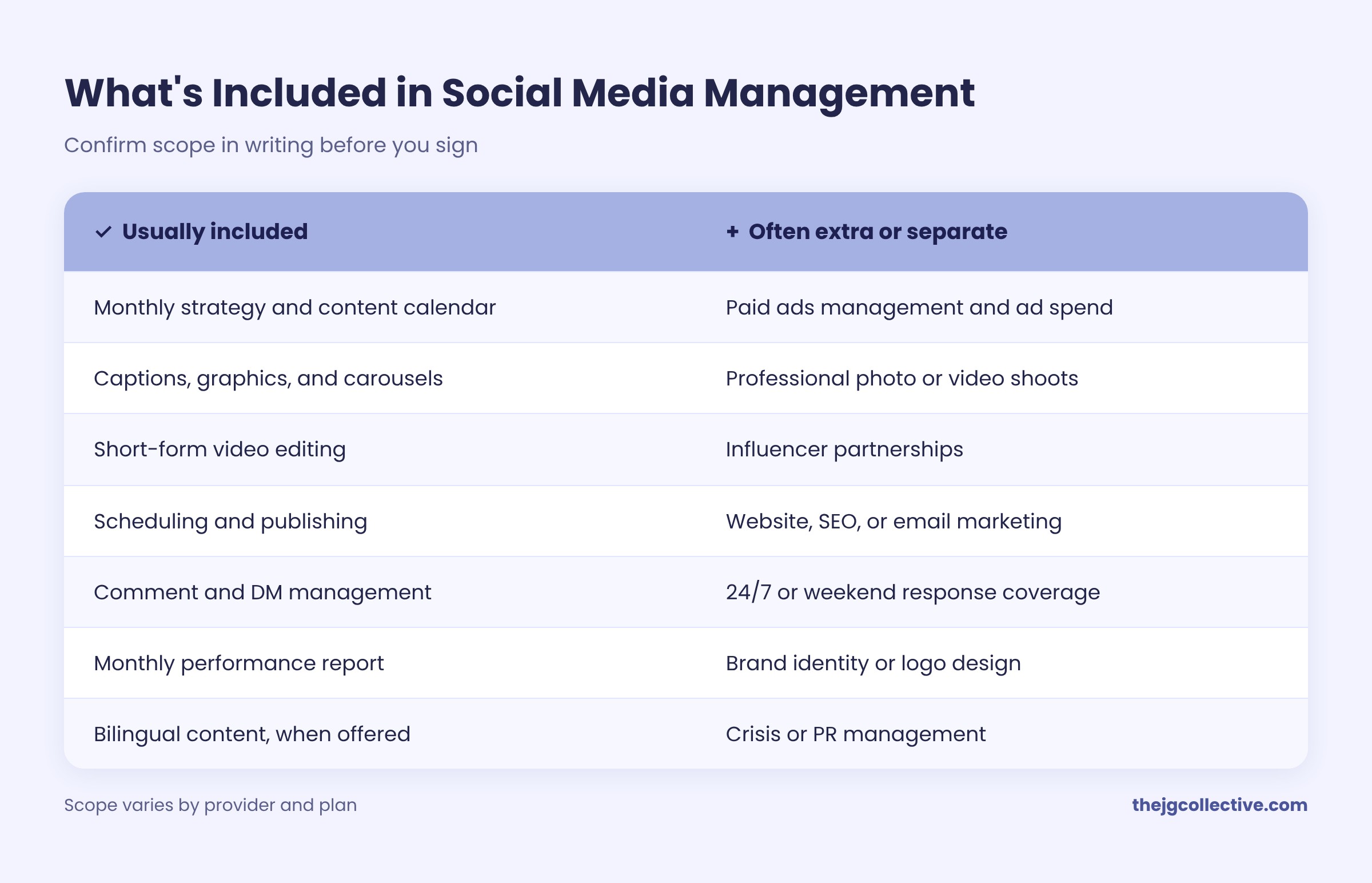
At JG Collective, every social media plan includes English and Spanish content options, because many Utah businesses serve both audiences and lose half of them with English-only posts.
What the monthly report should show
A report full of likes is a report that hides the answer. The metrics worth tracking fall into three layers.
1. Visibility: Are the right people seeing it?
- Reach and impressions
- Follower growth, especially local followers
2. Engagement: Are they paying attention?
- Engagement rate (interactions divided by reach)
- Saves and shares, which signal content people value
- Profile visits
3. Business results: Is it bringing in customers?
- Website clicks from social
- DMs and inquiries
- Calls, bookings, or form fills tracked to social
- Leads or sales attributed through UTM links
Most reports stop at layer two. If your manager can't connect social activity to layer three, you're paying for attention, not revenue. A strong report also ends with recommendations: what to repeat, what to stop, and what to test next month.
Red flags: signs your social media manager isn't doing the job
- No content calendar. Posts appear randomly, with no monthly plan you can review.
- No approvals. Content goes live without you ever seeing it, or you see it too late to change.
- Unanswered comments and DMs. Messages sit for days. Every unanswered DM is a lead walking away.
- Vanity-only reporting. You get follower counts and likes, but never clicks, inquiries, or bookings.
- Same post on every platform. Identical content on Instagram, Facebook, and LinkedIn signals no platform strategy.
- No recommendations. The report says what happened but never what to change.
- Promises of viral growth. Nobody can guarantee virality. Anyone who does is selling volume, not results.
The test is simple. After 90 days, you should be able to answer one question: what did social media do for the business? If your manager can't help you answer it, the system is missing.
Do it yourself or hire a social media manager?
Cost depends on scope: the number of platforms, posts per month, video volume, and whether engagement and reporting are included. For a full breakdown, see our guide on how much social media management costs for a small business.
The better question is what your time is worth. If the owner spends 30 hours a month on social media, that's nearly a full work week taken from sales, operations, and customers.
DIY makes sense when:
- You're just starting and need to learn what your audience responds to
- You have more time than budget
- Someone on your team enjoys it and has a few hours a week
Hiring makes sense when:
- Posting is inconsistent because the business keeps getting in the way
- You're posting but can't tell if it's bringing in customers
- You need bilingual content and don't have the language skills in-house
- You want social media connected to the rest of your marketing: SEO, ads, and your website
Not sure which fits? Our post on DIY vs. freelancer vs. agency walks through the trade-offs.
Frequently asked questions
What does a social media manager do daily?
Daily work focuses on community management: replying to comments and DMs, monitoring mentions, engaging with other accounts, and posting Stories. Content creation and planning happen in larger weekly or monthly batches.
How many hours a month does a social media manager spend on one small business?
For two platforms and three to four posts a week, expect roughly 25 to 40 hours a month. More platforms, more video, or daily posting increases that.
How many posts should a social media manager create each month?
Most small businesses do well with 12 to 20 feed posts a month across their main platform, plus Stories. Consistency matters more than volume.
What should a social media manager report each month?
A monthly report should cover reach, engagement rate, follower growth, website clicks, and leads or inquiries from social, plus recommendations for next month.
Does a social media manager run paid ads?
Sometimes. Many plans cover organic content only, with paid ads managed as a separate service. Confirm this in the scope before signing.
How long before social media management shows results?
Expect early engagement signals in the first 30 to 60 days. Consistent lead and revenue impact usually takes about 90 days, which is why many agencies start with a 90-day commitment.
The bottom line
A social media manager isn't paid to post. They're paid to run a monthly system: plan with intent, create content your customers care about, respond before leads go cold, and prove what's working with numbers tied to the business.
If your social media feels busy but your phone isn't ringing, the posts aren't the problem. The system is.
Want social media that brings in customers, not just likes? JG Collective builds bilingual social media systems for Utah small businesses, with monthly planning, content, engagement, and reporting tied to real results. Book a free consultation and we'll show you what your first 90 days would look like.